The advantage of hiring a Commercial Building Inspector will allow you to understand the true condition of the building you are contemplating purchasing. The exterior and cosmetic finishes of a building never tell the complete story and only an experienced Commercial Inspector will fully evaluate and document those hidden issues.
As a member of the National Association of Commercial Building Inspectors, we have inspected projects and purchases that have exceeded 30 million dollars in value. We have been chosen as the inspectioncompany of choice by a major North American investment company and have inspected their purchases in most of Southern Ontario. Our knowledge and experience is second to none and we are extremely proud of our expansion into the United States where we conduct Quality Control inspections for International Oil companies and Mining Companies.
As a Certified Building Code Official you get the advantage of having your building inspected by an individual who has many years of experience in Plan Reviews, Renovation and New Construction inspections. We also have a 20 year Contract Inspector veteran who has reviewed and inspected every aspect of a Buildings Construction and Renovation. It is this type of knowledge and experience that will allow you to know the exact condition of the building you are considering purchasing.
Our reports are extremely detailed with pictures of every deficiency or maintenance defect. We document HVAC, Heating, Plumbing, Structural, Fire Separations, Exit Hardware, Life Safety Equipment, Parking Lots, Exterior Cladding, Windows & Doors, Roof Coverings, Ventilation, Loading Docks and visually inspect your sprinkler systems.
We utilize the ASTM DE2018-08 Standard for Property Condition Assessments as a basis for all our inspections. This is a guideline which outlines what deficiencies are inspected for and also sets out the performance of the subject building. The final report is always based on the clients requirements which are decided upon prior to inspection.
Here are some industry guidelines for life expectancy on building items:
Air conditioning compressor – hermetically sealed 12 to 15 years
Air conditioning compressor – water-cooled 20 years
Air conditioning compressor – reciprocating 20 years
Rooftop heating and air conditioning unit 20 years
Copper core boiler – heat exchanger 15 to 20 years
Steel core boiler – heat exchanger 10 to 15 years
New cast iron core boiler – heat exchanger 20 to 25 years
Old cast iron core boiler – heat exchanger 30 to 50 years
Steel tube boiler – heat exchanger 20 to 40 years
Heat exchanger – standard rooftop unit 15 to 20 years
Heat exchanger downstream of a cooling coil 10 to 20 years
Heat exchanger – standard indoor system 20 to 25 years
Cooling tower 20 to 25 years
Central chiller 20+ years
Air handler 20 to 30 years
Gas-fired ceiling-mount unit heater 15 to 25 years
Gas-fired ceiling-mount radiant heater 20 to 25 years
Built-up asphalt and gravel roof system 20 to 25 years
Modified bitumen roof system 15 to 20 years
Inverted EPDM rubber or PVC roof system 20 to 25 years
Asphalt paving for car parking 20 years
Asphalt paving for trucks 15 years
Sealed, double glazed windows 20 to 30 years
Plywood overhead doors 15 years
Pre-finished steel overhead doors 20+ years
Electrical transformer 30 years
Electrical switchgear 20 to 40 years
Most buyers who are investing in a building for their own use, are unaware that if the building does not have enough power for their needs, they will usually be responsible for cost of upgrade. This is the type of expense that may not be included in your inspection unless you hire a company who has experience in knowing what concerns may affect a potential buyer.
Knowing the condition of your building prior to purchase gives you the option of walking away, if you decide it maybe a “Money Pit”, or negotiating a price reductions to reflect repairs required. Often a seller is not even aware of the condition of his building and can be very receptive to negotiation when faced with evidence of deficiencies.
Most major lenders will require a Phase 1 Environmental Assessment of Property prior to approving funding. We offer Level 1 and Level 11 assessments at competitive rates. Our Environmental Assessments are approved by all major lenders.
Welcome to Barrie ON, a vibrant waterfront community situated on beautiful Kempenfelt Bay.
The City of Barrie is a friendly, safe and exciting city with a reputation for its high standard of living and social atmosphere. Barrie’s close proximity to the Greater Toronto Area, beautiful properties and many amenities make it an ideal location for your business and place of residence. Barrie is continually expanding to meet the needs of people who have chosen Barrie as the place to raise their family.
As one of a Central Ontario leading cities and has a dynamic waterfront community of approximately 130.000 people. Convenient access to highways 401 and 407 are provided by the 400 and, highways 90, 27 and 11 provide alternate access routes to the rest of Ontario. Our local airport, Lake Simcoe Regional Airport offers customs and cargo handling capability. Also, the newly resumed GO service from Toronto to Barrie is popular with commuters.
The annual Kempenfest festival, held on the August long weekend along the waterfront, is recognized as one of the largest outdoor arts and crafts festivals in North America. This event is fun for the whole family and is always a hit with the locals and visitors.
An attractive city with swimmable beaches and challenging ski opportunities located minutes from your front door. An abundance of parks line beautiful Kempenfelt Bay with extensive biking, roller blading and walking trails. Cultural attractions include the renowned Gryphon Theatre, and international concert and performance venue at the Barrie Molson Centre , a 4,200 seat multi-purpose entertainment facility, the Mady Center and the MacLaren Art Centre .
Barrie also offers the Royal Victoria Hospital , a regional health care facility with a new Cancer Wing; Georgian College , which now offers university programs; a strong and diverse retail and commercial sector; and first class recreation, transportation and municipal services.
At its inception, the city was an establishment of houses and warehouses at the foot of the Nine Mile Portage from Kempenfelt Bay to Fort Willow. The Nine Mile Portage is an aboriginal transportation route that existed centuries before Europeans came to Simcoe County. The portage linked Kempenfelt Bay through Willow Creek, connecting Lake Simcoe to the Nottawasaga River which flows into Georgian Bay off Lake Huron.
Barrie played an integral role in the War of 1812. During the War, the city became a supply depot for British forces, and in addition, the Nine Mile Portage was adopted by the British Military as a key piece of their supply line which provided a strategic path for communication, personnel, and vital supplies and equipment to and from Fort Willow and Georgian Bay / Lake Huron. Today, the Nine Mile Portage is marked by signs along roads in Barrie and in Springwater Township. You can follow the scenic path from Memorial Square all the way to Fort Willow.
The city was named in 1833 after Sir Robert Barrie, who was in charge of the naval forces in Canada and frequently commanded forces through the city and along the Nine Mile Portage.
Barrie was also the final destination for one branch of the Underground Railroad. In the mid-19th century, this network of secret routes allowed many American slaves to enter Barrie and the surrounding area. This contributed to the development (and name) of nearby Shanty Bay.
Barrie Real Estate has always been a good investment for home buyers and investors. Home prices continue to increase and the rental market in Barrie is very strong with a low occupancy rate. Many people from bigger cities, such as Toronto, have chosen to invest in Barrie as a hedge against inflation, to protect their retirement investments.
The City of Barrie is currently in the process of re-vitalizing the downtown area. This includes setting up patios for local bars and pubs for the summer months and adding trees to vacant lots to make the downtown look more attractive. Future developments may include a downtown market which may end up near the bus terminal area close to the waterfront.
The waterfront is also being changed with parks expanded, roads being moved and construction going on everywhere. Barrie’s waterfront is a busy place in the summer with events for every weekend. The City Marina is located along the boardwalk and is an ideal place to launch your watercraft from.
Pre-engineered roof trusses provide the frame for your roof system. These trusses are usually fabricated from 2-by-4 lumber into a shape that resembles a triangle with the letter W inside of the triangle. Trusses spread your roof load to exterior walls which is continued down to footings. The bottom chord of the roof truss forms the ceiling joist and the bottom chord is immersed in insulation while the rest of the truss is not, stresses that set up in winter within the truss cause the truss to lift upward to some degree.
Truss uplift is a phenomenon common in newer homes built with roof trusses and is normally due to moisture differential between the bottom chords and the top chords of the trusses. Top floor ceiling will rise up in the winter and drop back down in the summer. Needless to say, this is a little disconcerting to most homeowners.
When wood shrinks, it shrinks differently along the grain than perpendicular to the grain. It shrinks much more at right angles to the grain, than along the grain. Studs don’t get shorter, but they get thinner in thickness and in width.
At first glance, one might assume that the floors have settled. Actually the ceiling has gone up – sometimes creating a gap as large as an inch where interior walls meet the ceilings. In the winter the warm air from the ceiling below and the thickness of the insulation keeps the bottom chord dry, causing them to shrink. While the top chords are absorbing moisture and being kept damp with the high humidity in the attic. The dampness of the top chords of the trusses cause them to expand. This differential movement in the top and bottom chord of the trusses causes them to arch up in the center. When the trusses arch up it causes cracks in the ceilings at the center of the building. As the trusses dry out with the warm summer air they drop back down closing most of the cracks.
To help combat damage to drywall from truss uplift Drywall manufacturers recommend that when attaching drywall to the bottom of a truss the attachment should be about 16 inches away from an intersecting wall. Another option is to attach trim to ceiling and not nail it to wall, allowing it to move up and down with the trusses.
When building a new home there is a framing clip is available today that’s designed to stabilize interior walls to the truss bottom. The clip allows the truss to move up and down without dragging the walls along with it. Most subdivision homes will not be using these as the framers get no extra money for installing “luxury items”.
As a preferred supplier with Brookfield Global Relocation Services for Borden ON, we guarantee to provide you a quality service that helps military personnel through every step of their relocation process. Our objective is to make relocation as easy and cost-effective as possible, while ensuring all you and your family’s needs are met. We like the transferee to be involved in every step of the process so that they know they needs and wants are number one right from the start. We are a Cross Canada Network of IRP DND Relocation specialists who are experts with the Brookfield Integrated Relocation Program (IRP) and all of the paperwork involved. Whether you are buying or selling, we guarantee we will make the transition into your new home smooth and stress free. If you are interested in this service, please contact us immediately for a consultation regarding meeting your families Real Estate needs.
Military families posted to CFB Borden will often choose one of the neighboring communities to relocate their family to. The town of Angus, located in the Township of Essa has had a close relationship with Borden since it was opened as a training base in 1916 to train units for Canadian Expeditionary Force. The original camp constructed at Borden was built by the Barrie and Collingwood companies of the Simcoe Forresters.
Borden was also the first flying station of the Royal Flying Corps of Canada and was also used by the RCAF as a training area. During the 1950’s the flying was moved to other locations, such as; Trenton, Cold Lake and North Bay. Borden eventually became a mainly training facility for the Canadian Armed Forces.
Real Estate has increased in value a steady rate in the Angus Borden area due to investment in infrastructure and the building of new schools. Angus recently just opened a new high school which was a welcome addition to military families with teenagers living in the area. Borden used to have its very own high school but it was closed during a period of downsizing and the education was turned over to the Simcoe Board of Education, who bused the children of military families as far away as Midland if they required schooling in French.
Brookfield GRS has been awarded the contract to provide Integrated Relocation Program benefits to Military Personnel transferred to bases across Canada. As part of the DND Relocation program there are approved service providers who are authorized to participate in the IRP program.
Bill Forsyth is the most experienced Realtor in the Borden Angus area and knows the pros and cons of the various neighborhoods in the Angus Borden real estate market. When purchasing a home in an unfamiliar location, it is very important to work with a Realtor who knows the area extremely well. Bill and his daughter Jenna will provide the facts and the knowledge to ensure you choose the neighborhoods that would be best suited for your family, these are areas that are most likely to appreciate in value. Bill and Jenna will provide the latest information on schools and your new community, and put you in touch will any professional help to make your move as easy and stress free as possible.
Your Realtor is an approved member of Brookfield Global Relocation Services and Transferease Relocation Inc., the trusted leaders for domestic and international relocations throughout the world. TransferEASE is a relocation company whose objective is to offer corporations and their transferring employees a professional, comprehensive approach to the move through more effective means of communication, a better understanding through exchange of information and a commitment to action Brookfield GRS provides services to both corporate and government clients with offices on 5 continents, including 28 military base locations and 4 regional offices across Canada.
Information on How the Brookfield Integrated Relocation Program (IRP) works for you:
Government entities authorize their employees to relocate. Brookfield GRS administers their relocation according to one of 3 different directives/policies:
Royal Canadian Mounted Police IRP Policy
Canadian Forces IRP Directive
National Joint Council IRP Directive
Whether you are with the Canadian Forces, the Government of Canada, the Royal Canadian Mounted Police, or relocating for career reasons, you can trust the experience and resources Linda Knight provides.
As a preferred supplier with Brookfield Global Relocation Services for Borden ON, I guarantee to provide you a quality service that helps military transferees through every step of their relocation process. Our objective is to make relocation as easy and cost-effective as possible, while ensuring all you and
This is a list of problems, in random order, that I have encountered during a home inspection and some are important enough to change a buyers mind.
Visible signs of water running through a basement. Although most new home buyers will not encounter this problem, you would be surprised at how many older homes may have this problem. Personally I think this problem would prevent me from buying that home every time.
Visible structural movement of masonry or poured concrete walls. Unless the structural movement was caused by being hit by a vehicle, this is again one of those deficiencies that would make me walk away. If there are problems with a home’s foundation then it will cause problems with the whole house.
Galvanized plumbing is mainly found in century type homes and can be a major headache. The biggest problem is that many insurance companies will not insure a home which has galvanized plumbing installed. One reason is the it is already long past its life expectancy and could fail at any time. Some home owners have all visible galvanized replaced but leave it in place in service chases up to first and second floor fixtures.
No Building Permit for Renovations can be very detrimental to the sale of a home. Depending on the size of the renovation and the amount of plumbing, electrical and HVAC work done, the financial implications can be quite daunting to a home buyer. No permit indicates that none of the home systems were inspected prior to covering with finished product. The cost of removing drywall and / or flooring to replace or repair any of the systems would probably be greater than the cost of the original renovation.
Vermiculite insulation is present in many older homes and may or may not contain traces of asbestos. Although there was only one mine in Libby, Montana, which produced the contaminated insulation, it was sold under many Trade names. You cannot tell if a particular batch of vermiculite has asbestos without laboratory testing. An attic full of asbestos would be considered a Class Two hazard and is expense to have removed. Read more …..
Aluminum wiring was commonly used in place of copper in the early 1980’s due to high price of copper. Many insurance companies will not insure a home that has aluminum wiring due to its susceptibility to corrosion which causes heat and could potentially cause a fire. Many home owners go to great lengths to try and hide the fact that there is aluminum wiring. Usually any accessible aluminum wire is replaced with copper. Read more…..
60 amp Services are not acceptable to most insurance companies in Canada. Many older homes, especially cottages which have been turned into four season homes, will often have a 60 amp service unless it has been upgraded. I have inspected many homes that have a 100 amp service panel but are supplied by a 60 amp switch. The size of the panel on the wall is not the governing factor, the size of switch controlling the power coming in determines what amperage is available.
Pony Panels connected to bus bars in main panel . You are not allowed to take a electrical feed directly off the bus bar in the main panel. The feed for the sub panel must come from a breaker to provide protection for the feed. Many older panels are found to have had one or two pony or service panels hooked directly to the bus bar which is not permitted.
Sump pumps are sometimes hooked directly into municipal drains. This may be permitted by the municipality in exceptional circumstances but is typically not allowed. Some municipalities have hefty fines if they find someone discharging sump pump into municipal drain.
Reversed polarity on wall outlets is quite common when homeowners do their own electrical wiring. Since electrical outlet now have holes in back of outlet where you can just insert the bare electrical cable the amount of reversed polarity deficiencies has increased dramatically. When using the outlet screws to secure the wire most people figured out that the black wire went on the dark screw and the white wire went on the light screw, but when using the push in the hole method, it became a 50/50 crap hoot. Unless you have a electrical tester you would never know the difference. When a circuit has reversed polarity the light fixture socket where the bulb screws in would now become live and if you touched it while screwing in a light bulb you would get a shock.
Basement stairs not protected on open side. Most people are completely un-aware that when your basement is un-finished your basement stairs is allowed to have an open side. Technacally as soon as you finish part of your basement you are required to protect the open stairs with wall, partial wall or guards to within 600 mm of floor. Height of guards or wall is to be a minimum of 900 mm. Also when basement is finished you should have a 3 way light switch which can be operated from either the top or bottom of stairs.
Extension Cords used as permanent wiring. The electrical code does not allow extension cords to be used as permanent wiring. 70% of garages I go into have an extension cord powering the auto door opener. Recent changes in Ontario requires outlets to be installed for each door for new construction, which makes sense and you have to wonder why it took so long, it’s not like they just invented the auto door opener.
There are many Associations for Home Inspectors to belong to in Canada and the U.S. Most Home Inspection Associations require their members to follow their Standards of Practice and follow their Code of Ethics. These are both available on every professional home inspection association website.
The typical Standards of Practice are the typical minimum standards of performance and will also define and clarify the purpose, terms, conditions, exclusions related to the home inspection. The Standard Code of Ethics usually lays out the home inspectors duty to act in a fair, honest and unbiased manner when conducting a home inspection. This is where a Realtor giving business to a “favorite home inspector” because of “favorable reports” would be considered unethical.
Typical Standards of Practice do not vary much between Associations, although some try to influence potential clients by calling their Standards “National Standards” or other inflated titles. Every home inspector basically looks at every visible item in your home and notes deficiency and will usually suggest a corrective action. Some home inspectors offer extra services such as Thermal Imaging or Mould Testing. Experience is still considered the biggest asset a home inspector can have.
Wikipedia defines a home inspection as: ” A home inspection is a limited, non-invasive examination of the condition of a home, often in connection with the sale of that home. Home inspections are usually conducted by a home inspector who has the training and certifications to perform such inspections. The inspector prepares and delivers to the client a written report of findings. The client then uses the knowledge gained to make informed decisions about their pending real estate purchase. The home inspector describes the condition of the home at the time of inspection but does not guarantee future condition, efficiency, or life expectancy of systems or components.”
This is a Standard “Boiler plate” type of description that most professional home inspectors have included in their Pre-Inspection Agreement which they will require the client to sign before conducting the inspection. The Pre-Inspection Agreement will usually stipulate what and what not is included in the inspection. Having a client sign a Pre-Inspection Agreement does not protect a home inspector from negligence in performing their duties though.
A Professional Home Inspection will usually start of the roof, which in Canada, can only fully be inspected for about nine months of the year, due to ice and snow coverage. Veteran Realtors will usually have the dates available when the roof was last re-shingled when applicable. The Exterior of home is then visually inspected with attention being paid to grading and any probable water concerns. The cladding, windows, doors, exterior electrical, exterior decks and patios are all inspected for deficiencies and pictures are taken of any issues or problems noted.
The basement is the hub of your homes systems and this is where you should pay close attention to what your home inspector is looking at and ask questions about anything you are un-sure of. You heating, a/c, plumbing, hot water, structural, electrical systems are typically located in your basement and this means that a lot of money you are investing is located there.
Another important feature involving basement inspections is the famous, “Do It Yourself” renovation. The majority of home owners do not obtain a “Building Permit” for basement renovations. This immediately tells the home inspector that the framing, electrical, plumbing and insulation etc was never inspected prior to being covered with drywall etc. This common occurrence can have huge ramifications to the home buyer, such as; problems in future with Building Department, incorrectly installed plumbing or electrical which may require changes or replacement. A great example of this is when homeowner uses steel framing but does not use proper grommets or hold offs for electrical cable. To repair this the entire wall would have to be opened up to install the electrical cables correctly. Some homeowners will tap of bus bars on main panel rather than upgrade service panel which again can be an expensive repair to bring panel up to electrical code requirements.
Plumbing is another area where “Do It Yourself” home owners excel at. Illegal venting and lack of venting are frequent offenders. Hooking up sump pumps into municipal drains can get you a hefty fine from your municipality if caught. Whether plumbing, heating or electrical deficiencies, it seems some home owners are only restricted by their imaginations when installing or modifying a homes systems.
The list of deficiencies your home inspector may find in any home is too long to detail. This is why hiring an experience home inspector is a great investment decision when purchasing a home. The home inspection fee is worth the Peace of Mind you will receive after reading your report. Just one identified deficiency in any of homes major systems would most likely save you a lot more money than you ever would pay for a home inspection. The Home Buyer always has to keep in mind that Home Inspectors are not psychic and cannot un-cover a deficiency if the Home Seller is actively covering up or hiding deficiencies. Even water leaks in basements can be hidden by patching and fresh paint and if they don’t declare their knowledge when listing their home, the home buyer may be in for a nasty surprise in the Spring.
Many people are complaining about the use or value of the SPIS. This form, promoted by the Ontario Real Estate Association (OREA), the seller’s property information statement (SPIS) continues to be a source of never-ending business for litigation lawyers and endless grief for unlucky buyers and sellers who are being swept into the bottomless pit of lawsuits because they used it.
CAVEAT EMPTOR – BUYER BEWARE An educated consumer is a smart consumer!
Buying a Home versus Renting – By the Barrie Home Inspector
There are many reasons why individuals choose to rent a home. The biggest reason is the upfront costs of purchasing a home. These costs include, making a down payment, home inspection fee, closing costs, home insurance, legal fees and moving expenses. Some people have uncertainty in their career or ability to earn a wage.
Buying a home allows people to start building equity and gives them the freedom to decorate or modify their home as they see fit. Pride of home ownership and the ability to perform your own maintenance is a big plus for most people. An article in the New York Times claims the average home owner would actually save over $10,000.00 over a 6 year period compared to renting the same house.
With today’s low interest rates many first time home owners are jumping into the market. Many renters don’t realize they have the means to purchase their own home or the benefits of homeownership as compared to renting.
Over the last ten years, the cost of rental housing in North America has increased an average of 3.5% per year. If that trend continues, that means that an apartment or home renting for $1,000 per month will cost more than $1,300 a month in ten years. If you rent the same home for ten years, the total amount you would pay for rent will equal $140,777!
Mortgage interest deductions, mortgage principal accumulation, property tax deductions, and home appreciation are factors to take into consideration when deciding to purchase a home. Home buyers in the United States can deduct interest from their Federal Income Tax making affording a home even more easier.
For most Americans, owning a home is their largest financial asset and a major component of their investment strategy. The NATIONAL ASSOCIATION OF REALTORS® estimates that the value of an average home rises by 4.5 percent a year. That’s a healthy return on investment. Still, no investment is guaranteed. Many Americans lost value in both their homes and investment accounts in the last couple of years, and it will take some time to recover.
Homeownership is how many families begin to accumulate wealth. According to the most recent data from the Federal Reserve Board, a homeowner’s net worth is 34.2 times that of a renter’s. (Median net worth of $174,500 for owners versus $5,100 for renters.) Families who own their home tend to move less than renters. This leads to more stable neighborhoods where there is more community involvement and sometimes even less crime.
You may wonder whether it is worthwhile to wait to purchase your home until prices are at their lowest. Prices are not the only factor that should drive your decision. Currently, interest rates are at all time lows that greatly improve the affordability of homes, especially for first time home buyers. Talking with a Certified Financial Planner can help you decide if you are ready to jump into home ownership. Your local bank may have financial planners on staff or maybe able to refer you.
Test your home for radon — it’s easy and inexpensive.
Fix your home if your radon level is 4 picocuries per liter, or pCi/L, or higher.
Radon levels less than 4 pCi/L still pose a risk, and in many cases may be reduced.
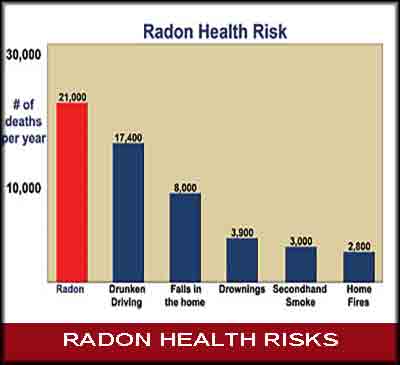
Radon is estimated to cause thousands of lung cancer deaths in the U.S. each year.
* Radon is estimated to cause about 21,000 lung cancer deaths per year, according to EPA’s 2003 Assessment of Risks from Radon in Homes (EPA 402-R-03-003). The numbers of deaths from other causes are taken from the Centers for Disease Control and Prevention’s 2005-2006 National Center for Injury Prevention and Control Report and 2006 National Safety Council Reports.
Top of page
Overview
Radon is a cancer-causing, radioactive gas.
You can’t see radon. And you can’t smell it or taste it. But it may be a problem in your home.
Radon is estimated to cause many thousands of deaths each year. That’s because when you breathe air containing radon, you can get lung cancer. In fact, the Surgeon General has warned that radon is the second leading cause of lung cancer in the United States today. Only smoking causes more lung cancer deaths. If you smoke and your home has high radon levels, your risk of lung cancer is especially high.
Radon can be found all over North America
Radon comes from the natural (radioactive) breakdown of uranium in soil, rock and water and gets into the air you breathe. Radon can be found all over the U.S. It can get into any type of building — homes, offices, and schools — and result in a high indoor radon level. But you and your family are most likely to get your greatest exposure at home, where you spend most of your time.
You should test for radon.
Testing is the only way to know if you and your family are at risk from radon. EPA and the Surgeon General recommend testing all homes below the third floor for radon. EPA also recommends testing in schools.
Testing is inexpensive and easy — it should only take a few minutes of your time. Millions of Americans have already tested their homes for radon (see How to Test Your Home).
You can fix a radon problem.
Radon reduction systems work and they are not too costly. Some radon reduction systems can reduce radon levels in your home by up to 99%. Even very high levels can be reduced to acceptable levels.
New homes can be built with radon-resistant features.
Radon-resistant construction techniques can be effective in preventing radon entry. When installed properly and completely, these simple and inexpensive techniques can help reduce indoor radon levels in homes. In addition, installing them at the time of construction makes it easier and less expensive to reduce radon levels further if these passive techniques don’t reduce radon levels to below 4 pCi/L. Every new home should be tested after occupancy, even if it was built radon-resistant. If radon levels are still in excess of 4 pCi/L, the passive system should be activated by having a qualified mitigator install a vent fan. For more explanation of radon resistant construction techniques, refer to EPA publication, Building Radon Out: A Step-by-Step Guide on How to Build Radon-Resistant Homes (PDF) (84 pp., 5.5 M).
Top of page
How Does Radon Get Into Your Home?
Any home may have a radon problem
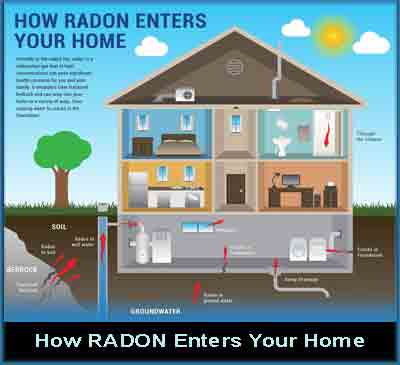
Radon is a radioactive gas. It comes from the natural decay of uranium that is found in nearly all soils. It typically moves up through the ground to the air above and into your home through cracks and other holes in the foundation. Your home traps radon inside, where it can build up. Any home may have a radon problem. This means new and old homes, well-sealed and drafty homes, and homes with or without basements.
Radon from soil gas is the main cause of radon problems. Sometimes radon enters the home through well water (see “Radon in Water” below). In a small number of homes, the building materials can give off radon, too. However, building materials rarely cause radon problems by themselves.
RADON GETS IN THROUGH:
Cracks in solid floors
Construction joints
Cracks in walls
Gaps in suspended floors
Gaps around service pipes
Cavities inside walls
The water supply
Nearly 1 out of every 15 homes in the U.S. is estimated to have elevated radon levels. Elevated levels of radon gas have been found in homes in your state. Contact your state radon office for general information about radon in your area. While radon problems may be more common in some areas, any home may have a problem. The only way to know about your home is to test.
Radon can also be a problem in schools and workplaces. Ask your state radon office about radon problems in schools, daycare and childcare facilities, and workplaces in your area.
Top of page
How to Test Your Home
You can’t see radon, but it’s not hard to find out if you have a radon problem in your home. All you need to do is test for radon. Testing is easy and should only take a few minutes of your time.
The amount of radon in the air is measured in “picocuries per liter of air,” or “pCi/L.” There are many kinds of low-cost “do-it-yourself” radon test kits you can get through the mail and in some hardware stores and other retail outlets. If you prefer, or if you are buying or selling a home, you can hire a qualified tester to do the testing for you. You should first contact your state radon office about obtaining a list of qualified testers. You can also contact a private radon proficiency program for lists of privately certified radon professionals serving your area. For links and information, visitwww.epa.gov/radon/radontest.html.
There are Two General Ways to Test for Radon:
Testing is easy and should only take a few minutes of your time.
SHORT-TERM TESTING:
The quickest way to test is with short-term tests. Short-term tests remain in your home for two days to 90 days, depending on the device. “Charcoal canisters,” “alpha track,” “electret ion chamber,” “continuous monitors,” and “charcoal liquid scintillation” detectors are most commonly used for short-term testing. Because radon levels tend to vary from day to day and season to season, a short-term test is less likely than a long-term test to tell you your year-round average radon level. If you need results quickly, however, a short-term test followed by a second short-term test may be used to decide whether to fix your home (see Home Sales).
How To Use a Test Kit:
Follow the instructions that come with your test kit. If you are doing a short-term test, close your windows and outside doors and keep them closed as much as possible during the test. Heating and air-conditioning system fans that re-circulate air may be operated. Do not operate fans or other machines which bring in air from outside. Fans that are part of a radon-reduction system or small exhaust fans operating only for short periods of time may run during the test. If you are doing a short-term test lasting just 2 or 3 days, be sure to close your windows and outside doors at least 12 hours before beginning the test, too. You should not conduct short-term tests lasting just 2 or 3 days during unusually severe storms or periods of unusually high winds. The test kit should be placed in the lowest lived-in level of the home (for example, the basement if it is frequently used, otherwise the first floor). It should be put in a room that is used regularly (like a living room, playroom, den or bedroom) but not your kitchen or bathroom. Place the kit at least 20 inches above the floor in a location where it won’t be disturbed – away from drafts, high heat, high humidity, and exterior walls. Leave the kit in place for as long as the package says. Once you’ve finished the test, reseal the package and send it to the lab specified on the package right away for analysis. You should receive your test results within a few weeks.
LONG-TERM TESTING:
Long-term tests remain in your home for more than 90 days. “Alpha track” and “electret” detectors are commonly used for this type of testing. A long-term test will give you a reading that is more likely to tell you your home’s year-round average radon level than a short-term test.
EPA Recommends the Following Testing Steps:
Step 1. Take a short-term test. If your result is 4 pCi/L or higher, take a follow-up test (Step 2) to be sure.
Step 2. Follow up with either a long-term test or a second short-term test:
For a better understanding of your year-round average radon level, take a long-term test.
If you need results quickly, take a second short-term test.
The higher your initial short-term test result, the more certain you can be that you should take a short-term rather than a long-term follow up test. If your first short-term test result is more than twice EPA’s 4 pCi/L action level, you should take a second short-term test immediately.
Step 3. If you followed up with a long-term test: Fix your home if your long-term test result is 4 pCi/L or more. If you followed up with a second short-term test: The higher your short-term results, the more certain you can be that you should fix your home. Consider fixing your home if the average of your first and second test is 4 pCi/L or higher. (see also Home Sales)
Top of page
What Your Test Results Mean
Test your home now and save your results. If you find high radon levels, fix your home before you decide to sell it.
The average indoor radon level is estimated to be about 1.3 pCi/L, and about 0.4 pCi/L of radon is normally found in the outside air. The U.S. Congress has set a long-term goal that indoor radon levels be no more than outdoor levels. While this goal is not yet technologically achievable in all cases, most homes today can be reduced to 2 pCi/L or below.
Sometimes short-term tests are less definitive about whether or not your home is above 4 pCi/L. This can happen when your results are close to 4 pCi/L. For example, if the average of your two short-term test results is 4.1 pCi/L, there is about a 50% chance that your year-round average is somewhat below 4 pCi/L. However, EPA believes that any radon exposure carries some risk – no level of radon is safe. Even radon levels below 4 pCi/L pose some risk, and you can reduce your risk of lung cancer by lowering your radon level.
If your living patterns change and you begin occupying a lower level of your home (such as a basement) you should retest your home on that level.
Even if your test result is below 4 pCi/L, you may want to test again sometime in the future.
Top of page
Radon and Home Sales
More and more, home buyers and renters are asking about radon levels before they buy or rent a home. Because real estate sales happen quickly, there is often little time to deal with radon and other issues. The best thing to do is to test for radon NOW and save the results in case the buyer is interested in them. Fix a problem if it exists so it won’t complicate your home sale. If you are planning to move, read EPA’s pamphlet “Home Buyer’s and Seller’s Guide to Radon,” which addresses some common questions (see also Radon in Real Estate). You can also use the results of two short-term tests done side-by-side (four inches apart) to decide whether to fix your home.
During home sales:
Buyers often ask if a home has been tested, and if elevated levels were reduced.
Buyers frequently want tests made by someone who is not involved in the home sale. Your state radon officecan assist you in identifying a qualified tester.
Buyers might want to know the radon levels in areas of the home (like a basement they plan to finish) that the seller might not otherwise test.
Today many homes are built to prevent radon from coming in. Building codes in your state or local area may require these radon-resistant construction features. If you are buying or renting a new home, ask the owner or builder if it has radon-resistant features. The EPA recommends building new homes with radon-resistant features in high radon potential (Zone 1) areas. Even if built radon-resistant, every new home should be tested for radon after occupancy. If you have a test result of 4 pCi/L or more, consult a qualified mitigator to estimate the cost of upgrading to an active system by adding a vent fan to reduce the radon level. In an existing home, the cost to install a radon mitigation system is about the same as for other common home repairs. For more information, refer to EPA’s Map of Radon Zonesand other useful EPA documents on radon-resistant new construction (see publications). See also EPA’s Indoor airPLUS new homes certification program.
Top of page
Radon in Water
There are two main sources for the radon in your home’s indoor air, the soil and the water supply. Compared to radon entering the home through water, radon entering your home through the soil is usually a much larger risk.
The radon in your water supply poses an inhalation risk and an ingestion risk. Research has shown that your risk of lung cancer from breathing radon in air is much larger than your risk of stomach cancer from swallowing water with radon in it. Most of your risk from radon in water comes from radon released into the air when water is used for showering and other household purposes.
Radon in your home’s water is not usually a problem when its source is surface water. A radon in water problem is more likely when its source is ground water, e.g. a private well or a public water supply system that uses ground water. If you are concerned that radon may be entering your home through the water and your water comes from a public water supply, contact your water supplier.
If you’ve tested the air in your home and found a radon problem, and your water comes from a well, have your water tested.
If you’ve tested your private well and have a radon in water problem, it can be fixed. Your home’s water supply can be treated in two ways. Point-of-entry treatment can effectively remove radon from the water before it enters your home. Point-of-use treatment devices remove radon from your water at the tap, but only treat a small portion of the water you use and are not effective in reducing the risk from breathing radon released into the air from all water used in the home.
For more information, call EPA’s Drinking Water Hotline at (800) 426-4791 or visit www.epa.gov/safewater/radon.html If your water comes from a private well, you can also contact your state radon office.
How to Lower the Radon Levels in Your Home
Radon and Home Renovations
If you are planning any major structural renovation, such as converting an unfinished basement area into living space, it is especially important to test the area for radon before you begin the renovation. If your test results indicate a radon problem, radon-resistant techniques can be inexpensively included as part of the renovation. Because major renovations can change the level of radon in any home, always test again after work is completed.
Since there is no known safe level of radon, there can always be some risk. But the risk can be reduced by lowering the radon level in your home.
There are several proven methods to reduce radon in your home, but the one primarily used is a vent pipe system and fan, which pulls radon from beneath the house and vents it to the outside. This system, known as a soil suction radon reduction system, does not require major changes to your home. Sealing foundation cracks and other openings makes this kind of system more effective and cost-efficient. Similar systems can also be installed in houses with crawl spaces. Radon contractors can use other methods that may also work in your home. The right system depends on the design of your home and other factors.
Ways to reduce radon in your home are discussed in EPA’s “Consumer’s Guide to Radon Reduction.” You can also download a copy from our radon publications page.
The cost of reducing radon in your home depends on how your home was built and the extent of the radon problem. Most homes can be fixed for about the same cost as other common home repairs. The cost to fix can vary widely; consult with your state radon office or get one or more estimates from qualified mitigators. The cost is much less if a passive system was installed during construction.
Lowering high radon levels requires technical knowledge and special skills. You should use a contractor who is trained to fix radon problems. A qualified contractor can study the radon problem in your home and help you pick the right treatment method.
Check with your state radon office for names of qualified or state certified radon contractors in your area. You can also contact private radon proficiency programs for lists of privately certified radon professionals in your area. For more information on private radon proficiency programs, visit www.epa.gov/radon/radontest.html. Picking someone to fix your radon problem is much like choosing a contractor for other home repairs – you may want to get references and more than one estimate.
If you are considering fixing your home’s radon problem yourself, you should first contact your provincial radon office for guidance and assistance
Most homes can be fixed for about the same cost as other common home repairs.
You should also test your home again after it is fixed to be sure that radon levels have been reduced. Most soil suction radon reduction systems include a monitor that will indicate whether the system is operating properly. In addition, it’s a good idea to retest your home every two years to be sure radon levels remain low.
The Risk of Living With Radon
Scientists are more certain about radon risks than from most other cancer-causing substances.
Radon gas decays into radioactive particles that can get trapped in your lungs when you breathe. As they break down further, these particles release small bursts of energy. This can damage lung tissue and lead to lung cancer over the course of your lifetime. Not everyone exposed to elevated levels of radon will develop lung cancer. And the amount of time between exposure and the onset of the disease may be many years.
Like other environmental pollutants, there is some uncertainty about the magnitude of radon health risks. However, we know more about radon risks than risks from most other cancer-causing substances. This is because estimates of radon risks are based on studies of cancer in humans (underground miners).
Smoking combined with radon is an especially serious health risk. Stop smoking and lower your radon level to reduce your lung cancer risk.
Children have been reported to have greater risk than adults of certain types of cancer from radiation, but there are currently no conclusive data on whether children are at greater risk than adults from radon.
Your chances of getting lung cancer from radon depend mostly on:
How much radon is in your home
The amount of time you spend in your home
Whether you are a smoker or have ever smoked
Radon Risk If You Smoke
Radon Level
If 1,000 people who smoked were exposed to this level over a lifetime*…
The risk of cancer from radon exposure compares to**…
WHAT TO DO: Stop smoking and…
20 pCi/L
About 260 people could get lung cancer
250 times the risk of drowning
Fix your home
10 pCi/L
About 150 people could get lung cancer
200 times the risk of dying in a home fire
Fix your home
8 pCi/L
About 120 people could get lung cancer
30 times the risk of dying in a fall
Fix your home
4 pCi/L
About 62 people could get lung cancer
5 times the risk of dying in a car crash
Fix your home
2 pCi/L
About 32 people could get lung cancer
6 times the risk of dying from poison
Consider fixing between 2 and 4 pCi/L
1.3 pCi/L
About 20 people could get lung cancer
(Average indoor radon level)
(Reducing radon levels below 2 pCi/L is difficult.)
0.4 pCi/L
About 3 people could get lung cancer
(Average outdoor radon level)
Note: If you are a former smoker, your risk may be lower. * Lifetime risk of lung cancer deaths from EPA Assessment of Risks from Radon in Homes (EPA 402-R-03-003). ** Comparison data calculated using the Centers for Disease Control and Prevention’s 1999-2001 National Center for Injury Prevention and Control Reports.
Radon Risk If You’ve Never Smoked
Radon Level
If 1,000 people who never smoked were exposed to this level over a lifetime*…
The risk of cancer from radon exposure compares to**…
WHAT TO DO:
20 pCi/L
About 36 people could get lung cancer
35 times the risk of drowning
Fix your home
10 pCi/L
About 18 people could get lung cancer
20 times the risk of dying in a home fire
Fix your home
8 pCi/L
About 15 people could get lung cancer
4 times the risk of dying in a fall
Fix your home
4 pCi/L
About 7 people could get lung cancer
The risk of dying in a car crash
Fix your home
2 pCi/L
About 4 person could get lung cancer
The risk of dying from poison
Consider fixing between 2 and 4 pCi/L
1.3 pCi/L
About 2 people could get lung cancer
(Average indoor radon level)
(Reducing radon levels below 2 pCi/L is difficult.)
0.4 pCi/L
(Average outdoor radon level)
Note: If you are a former smoker, your risk may be higher. * Lifetime risk of lung cancer deaths from EPA Assessment of Risks from Radon in Homes (EPA 402-R-03-003). ** Comparison data calculated using the Centers for Disease Control and Prevention’s 1999-2001 National Center for Injury Prevention and Control Reports.
It’s never too late to reduce your risk of lung cancer. Don’t wait to test and fix a radon problem. If you are a smoker, stop smoking.
Radon Myths
MYTH: Scientists aren’t sure radon really is a problem.
FACT: Although some scientists dispute the precise number of deaths due to radon, all the major health organizations (like the Centers for Disease Control and Prevention, the American Lung Association and the American Medical Association) agree with estimates that radon causes thousands of preventable lung cancer deaths every year. This is especially true among smokers, since the risk to smokers is much greater than to non-smokers.
MYTH: Radon testing is difficult, time consuming and expensive.
FACT: Radon testing is easy. You can test your home yourself or hire a qualified radon test company. Either approach takes only a small amount of time and effort.
MYTH: Homes with radon problems can’t be fixed.
FACT: There are simple solutions to radon problems in homes. Hundreds of thousands of homeowners have already fixed radon problems in their homes. Most homes can be fixed for about the same cost as other common home repairs; check with one or more qualified mitigators. Call your state radon office for help in identifying qualified mitigation contractors.
MYTH: Radon affects only certain kinds of homes.
FACT: House construction can affect radon levels. However, radon can be a problem in homes of all types: old homes, new homes, drafty homes, insulated homes, homes with basements, homes without basements. Local geology, construction materials, and how the home was built are among the factors that can affect radon levels in homes.
MYTH: Radon is only a problem in certain parts of the country.
FACT: High radon levels have been found in every state. Radon problems do vary from area to area, but the only way to know your radon level is to test.
MYTH: A neighbor’s test result is a good indication of whether your home has a problem.
FACT: It’s not. Radon levels can vary greatly from home to home. The only way to know if your home has a radon problem is to test it.
MYTH: Everyone should test their water for radon.
FACT: Although radon gets into some homes through water, it is important to first test the air in the home for radon. If your water comes from a public water supply that uses ground water, call your water supplier. If high radon levels are found and the home has a private well, call the Safe Drinking Water Hotline at 1 800-426-4791 for information on testing your water.
MYTH: It’s difficult to sell homes where radon problems have been discovered.
FACT: Where radon problems have been fixed, home sales have not been blocked or frustrated. The added protection is some times a good selling point.
MYTH: I’ve lived in my home for so long, it doesn’t make sense to take action now.
FACT: You will reduce your risk of lung cancer when you reduce radon levels, even if you’ve lived with a radon problem for a long time.
MYTH: Short-term tests can’t be used for making a decision about whether to fix your home.
FACT:A short-term test, followed by a second short-term test* can be used to decide whether to fix your home. However, the closer the average of your two short-term tests is to 4 pCi/L, the less certain you can be about whether your year-round average is above or below that level. Keep in mind that radon levels below 4 pCi/L still pose some risk. Radon levels can be reduced in most homes to 2 pCi/L or below.
* If the radon test is part of a real estate transaction, the result of two short-term tests can be used in deciding whether to mitigate. For more information, see EPA’s “Home Buyer’s and Seller’s Guide to Radon”.
Buying a house in the country or any rural area usually means you have a choice of propane or oil heat. After decades of heating with oil heat your insurance company is now becoming more finicky about what they will or will not insure.
Home buyers want to ensure they will comply with the requirements of their insurance company prior to signing an Offer to Purchase. Some home owners find themselves scrambling to obtain coverage after their insurance company tells them that their property is not insurable in the condition it is in.
Most people are aware that 90% of Insurance Companies will require a WETT Inspection prior to insuring a home, this has been common place for many years in Ontario and any experiences Realtor will ensure you are aware of this.
One of the less known requirements of Insurance Companies is the requirement to exceed the TSSA standard for metal thickness in oil storage tanks. Recently some insurance companies have started to change their underwriting requirements relating to steel oil tanks, and are indicating that “14 gauge, single wall” steel tanks will not be acceptable for insurance purposes.
Wow, you say, how can this be possible, the tank has a ULC Certification tag and is within the prescribed 10 years? Well it seems that Insurance Companies, based on their Underwriting experience, have decided that the risk is un-satisfactory. Some Canadian Insurance Companies will no longer accept 14 Gauge, single wall , steel storage tanks will not be acceptable for insurance coverage. This could put your mortgage at risk and threaten your closing.
This is a sample standard that some insurance companies are now using:
Metal tanks – Thickness of the metal – Stamped on the tag or sticker on the tank. (Fibreglass tanks do not have to follow this standard)
2.00 mm = 14 gauge – this is a very thin metal that is susceptible to breakdown. These are no longer being certified.
2.3 mm and above = 12 gauge – this is a heavier metal and is more durable than a 14 gauge tank
2.00 mm = Double Bottom tanks are acceptable but must be replaced sooner than 12 gauge tanks
Even in Northern Nunavut there are strict regulations and the responsibility for oil storage and leaks is firmly pointed directly at the home owner. This is the wording from their guideline; ´The homeowner is responsible for ensuring that his heating oil tank and accessories are kept in good working order and are in compliance with current environmental and other regulations and codes of practice. In the event of an oil spill, the homeowner is ultimately responsible for cleaning up the spill and further, bringing the affected land back to a condition that meets acceptable environmental standards.
In England they give specific Insurance Advice, which is;
Cleaning up oil spills is difficult and can be very expensive – we’re talking thousands of
pounds. Dealing with a spill will cause you and maybe your neighbors a great deal of
inconvenience. You should have insurance cover and your policy should include:
• the cost of replacing the lost oil
• the costs of cleaning up oil on your own property
• a high enough liability limit to cover you if neighboring land and/or boreholes
are affected
• environmental cleanup for accidental oil loss.
As you can see, an environmental cleanup can quickly reach a “million dollar” price tag if oil seeps into the ground and contaminates ground water or flows down drainage ditches requiring massive soil removal and cleanup. Relying on your Home Inspector or Realtor to inform you of various Insurance Company requirements is not within their area of expertise. So as always, Caveat Emptor – Buyer Beware. A Educated Consumer is a Smart Consumer and will ensure that all the i’s are dotted and t’s are crossed before , “Signing on the Dotted Line.”
A leaking roof can be a homeowner’s worst nightmare. This is because of the high costs and massive inconveniences associated with having to repair the roof and any associated interior water damage. Roof inspections are part of any home inspection and you will receive the approximate age of the roof shingles and general overall condition of shingles. Here are some tips on how to spot potential problems with your roof as well as information on what can cause roof damage and what kind of repairs maybe required.
The top five roof-related Issues
Shingle Condition
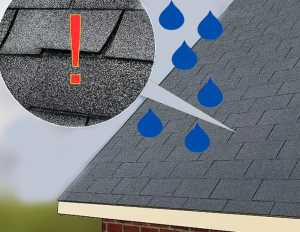
Discolored, missing or curling shingles on the roof: Spotting these on your roof is normally straightforward with the use of binoculars and perhaps even without them if the problem is quite pronounced. Any potential water penetration of shinlges can lead to water damage to your roofs sheathing. Eventually if left unchecked the water will eventually find its way into your home.
Roofs Gutters
Clogged or Damaged Gutters can lead to water damaging fascia or running under your soffit area. Water damage can cause mould, mildew and wood rot. Water spilling out of your gutter can also cause water to pool around your foundation which could lead to moisture issues in the basement.
Damaged Flashings
Damaged flashing. Flashing which protect your roof around the pipes, vents, valleys, plumbing stacks and chimneys, when damaged can cause water leaks. You can tell flashing is damaged if looks loose or is ripped. Sometimes when a roof shingles are replaced the roofer will only bend the flashing temporarly and then reuse the flashing to maintain that important water tight seal. Ensure when your shingles are replaced that new flashings will be installed.
Soffit damage
Soffits are the boards that go over the end of roof rafters. Sometimes birds and insects set up their own home there, causing damage. Rotting, cracks and holes are a giveaway to this problem. Even aluminum soffits can be damaged by raccoons trying to access your attic.
Rotting Fascia
A rotting fascia. The board that stretches along the front of your roof can start to rot due to moisture. A rotting fascia is easily spotted as the fascia often starts to disintegrate, break off or become discolored. Clogged or bent roofing gutter can allow water to cause mould, mildew or wood rot to fascias.
Typical Types of Roof Coverings
Asphalt composition shingles: These are cheap and easily obtainable, but they are less attractive than other options due to their flat appearance. This is by far the most popular type of roofing material.
Wood shakes or shingles: These are pricey but attractive shingles. They have great durability but aren’t a good choice in regions where there is a fire danger.
Metal Roofing: Metal roofs made of steel or aluminum have become more popular in recent years, due in part to their durability and because they are fireproof. These are expensive roofs that require specialty contractors for installation, but they may be cost-effective over the long run due to their long life. Several types of metal roofing systems are available, including raised-seam panels and products that mimic the look of composite shingles.
Slate roofing: This is a highly attractive, high-end roofing option, but it is expensive and very heavy. Slate roofs are extremely slippery to walk on and difficult to repair when damaged.
Composition slate: These synthetic tiles made from 95 percent recycled materials, including rubber, are gaining in popularity. They closely resemble slate and other forms of stone tile but are much lighter and less susceptible to damage.
Clay or ceramic tile: Long the most predominant image in Southern California and Florida, the so-called Spanish-style red tile roof is still common but is being gradually replaced by metal and composite materials that mimic the Spanish tile look. Other roofing materials are now available which meet ceramic tile’s fire retardant ability, with much less weight put on the roof. This type of shingle is called thehalf-barrelbecause it is essentially a cylinder cut in half length-wise, roughly 16 inches long.
All roofing systems rely on an overlap to shed water and resist wind uplift. Fiberglass based shingles are nailed to each other and to the roof deck. Additional weatherproof insurance is provided by strips of factory-applied adhesive. The adhesive is heat-sensitive, which makes the shingles self sealing. Most fiberglass shingles will have an approximate live span of 15 years. Typcially the south facing roofs shingles will be the first to fail, which is due to exposure to the sun which breaks down the shingles UV protection.
When buying a Home a lot of people really don’t understand the different types of Home Inspections. Every Home Inspector has different prices and offer different services as part of the home inspection. The Barrie Home Inspector offers Free Thermal Imaging with every Home Inspection. For example some Home Inspectors do not include Landscape Inspections as part of their services. Structural inspections of visible components are inspected and any concerns would be referred to a Structural Engineer. No Home Inspectors in Ontario are licenced.
Plumbing Inspections include checking fixtures, drains and venting that is readily visible to the Home Inspector. Types of plumbing are identified with galvanized pipes, lead pipes or Kitec Pex Plumbing being identified with a comment on the issues involved with these types of pipe.