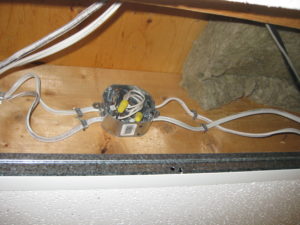
The attic is usually the last place to visit during your home inspection. Sometimes just entering the attic is a chore itself and sometimes not even possible. Some home owners will renovate a home and during the process cover up the attic access. This happens more often than you would think and prevents the buyer from knowing the true condition of the attic.
The most common deficiency that I come across in attics is the presence of rodents. Homes that have fiberglass insulation will typically have a varied level of mice infestation in their attic. Rodent proofing your attic will take some time and dedication to the task. Seal all holes and cracks with steel mesh and / or caulking, do not use plastics, rubber or wood that can be chewed. Use traps placed near entry points and empty traps frequently.
Many home owners or contractors will enter an attic to install alarm wiring, cable or to install a ceiling fan. When inspecting the attic there are many times where a trail is visible where individual has walked or crawled along the rafters compacting the insulation. In fiberglass, and most types of insulation, the air trapped between fibers is what gives an insulation factor to product. When insulation is compacted the R value is reduced and you create an area of heat loss in your attic.
Many attics are built using engineered wood trusses. Engineered trusses are designed to support a roof and the normal snow load for your area. If you hang a storage unit from an engineered wood truss you are technically required to have an engineer or designer produce a detail of proposed construction and having drawing stamped. Because the truss is an engineered product it comes under Part 4 of the Ontario Building Code regulations.
Soffit venting is probably the most important factor in preventing ices dams and allowing proper ventilation of your attic. The average roof requires 1 square foot of ventilation for every 300 square feet of roof, low slope roofs require 1 square foot for every 150 square feet of roof. The vents must be 25% on bottom and 25% on peak of roof with the remaining installed where required. It is considered a good construction practice to install upper vents on same side of roof so that air does not just cross over from one vent to the other. Soffit baffles are required to be installed at the eave of the roof to allow air from vented soffit to enter attic. Most subdivision homes will have a soffit vent installed in every third rafter bay.
Many older homes will have vents discharging into attic. Plumbing vents, bathroom exhaust fans and kitchen range exhausts should all ventilate to exterior of house. Newer homes are required to have a insulated wrap installed on exhaust ducts to prevent warm air condensing in attic and forming ice and potential blockage in winter.
Failing to properly ventilate your attic can allow moisture to build up and will eventually cause mould and damage to your sheathing and shingles. Over the years the required insulation for homes has changed. Newer homes will typically have R-50 of insulation installed. If you have an older home your insulation may require upgrading and your ventilation checked to ensure it is adequate.
Contact Barrie Home Inspector for more information or details.
Now that the snow is just around the corner now it the time to prepare for Old Man Winter. A little preparation now can prevent discomfort or even damage to your home once the snow flies. Here are some tips we think will help you be more prepared:
Furnace Tune Up
Your home furnace is like your car, it needs a tune up to ensure it is running at optimum performance. Ensure you use a company who is well known and has a good reputation, many rip off companies will install unneeded equipment just to increase profit margins.
Attic Insulation
Adding extra insulation to your attic can prevent ice dams which can damage your roofs shingles. Ensuring your attic has adequate ventilation is also very important. If you have had anyone working in your attic it is probably worth while popping your head up and having a look around. Many times contractors will not replace insulation after their work is completed.
Ceiling Fans
Having your ceiling fans rotate clockwise will help move any heat collecting on your ceilings down to floor area allowing you to reduce heat required to maintain the same comfort level.
Exterior Windows
If you have brick or split concrete window sills it is very important that you seal any cracks in mortar prior to winter. Water will penetrate cracks, be absorbed by the brick and freeze when temperatures drop. Clay fired bricks will typically spall in this situation and you will end up having to replace brick when sealing and caulking would have prevented damage.
Caulking
If you have had a home inspection or energy audit then you will have already been told about replacing and adding caulking on the exterior of your home. Caulking not only protects your exterior but also seals those drafts which increase energy required to heat your home. Recommend buying the contractors grade of caulking to extend life cycle and extend time to replacement.
Roof Inspection
Check your roof for loose shingles, gaps in flashing and gutters are clean. Ensure any tree branches close to roof are trimmed back as the weight of snow and ice can bring them into contact with your shingles causing early failure. If you are not comfortable on a ladder then hire a professional maintenance company to perform this task.
Chimney Inspection
Prior to firing up your wood stove or fireplace the fall is a good time to inspect and clean your chimney. Professional chimney sweeps are busy every fall so booking your chimney cleaning should not be put off. If you have a masonry chimney have it inspected to ensure all flashings and seams are sealed to prevent damage from water penetration and expansion due to freezing.
Exterior Water Supply
Turn off your exterior water supply valves from inside your home and open exterior valves to drain water. If you have a exterior sprinkler system ensure all water is turned off and system is blown out using compressed air. Drain all garden hoses and place in storage for the winter.
Sidewalks & Driveways
If you have gaps between your driveway and garage floor, fill the gaps with caulking to prevent expansion. Asphalt caulking will prevent water penetration and the eventual sagging that occurs on older driveways. If your concrete sidewalk has a gap between foundation ensure that gap is also filled as the force of expanding water will actually move your sidewalk creating a wider gap.
If you have questions about protecting your home call the Barrie Home Inspector for more information.
DIY Electrical Projects
Many home owners like to install electrical equipment and wiring. As a Professional Home Inspector I would like to list some of the common mistakes that I encounter when inspecting homes in the Barrie ON area. Note: Although a home owner is allowed to install his own electrical wiring, they are required to take out a permit and have installation inspected by the ESA.
Many home owners use metal stud walls in basements, which require special grommets or standoffs when installing electrical cables. Metal studs on basement exterior walls is not a good ideas as metal conducts heat and cold extremely well and can also cause moisture issues due to humidity in air contacting cold areas created by conduction of cold through metal studs.
Most custom builders will use the mould proof treated wood studs when framing in basements. Pressure treated lumber is recommended for sill plate with a moisture barrier between concrete and wood required by building code.
Junction Boxes
Ontario codes 12-3016(1) and 12-112(3) specify that all junction boxes must remain accessible. Junction boxes also require a cover plate to be installed.
Kitchen Installations
Kitchens require at least 2 15 amp multi-wire (split receptacles) or 20 Amp (T Slot receptacles) branch circuits to supply receptacles located along the kitchen counter work surface.
210.52(B)(1)
(1) Wall Counter top Spaces. A receptacle outlet shall be installed at each wall countertop space that is 300 mm (12 in.) or wider. Receptacle outlets shall be installed so that no point along the wall line is more than 600 mm (24 in.) measured horizontally from a receptacle outlet in
that space.
Exception: Receptacle outlets shall not be required on a wall directly behind a range, counter-mounted cooking unit, or sink in the installation described in Figure 210.52(C)(1).
This also includes the requirement for kitchen islands to have an outlet installed.
Ontario electrical code requires a dedicated electrical outlet to be located behind fridge location. This circuit is allowed to provide power to a clock also.
GFCI ( Ground Fault Circuit Interrupter)
Exterior receptacles within 8ft (2.5m) of finished grade (since 1975).
Bathroom & washroom receptacles (since 1986).
Receptacles within 5ft (1.5m) of all sinks (since 2006).
Hydro massage bathtubs must be GFCI protected.
Spas and hot tubs must be GFCI protected.
Receptacles, equipment, and buildings around pools have numerous requirements.
Metal Stud Wall Installation
The Ontario Electrical Safety Code requires that metal stud partitions be bonded to
ground so that the branch circuit over current device will operate in the event the studs become energized.
Securing Cable at Boxes
The electrical cable is required to be secured within 8” to 12” of box with a wire staple. Also you must have a 12” loop of unbroken cable on the outside of box or 6” of cable end available on the interior side of finished wall to permit replacement without major reconstruction.
Extension Cords
Flexible extension cords must never take the place of permanent wiring; they are not designed or intended for permanent installations. Once the task has been completed, the cord should always be disconnected and properly stored away for future use.
Protection of Electrical Cables
Electrical cable should be protected against mechanical damage where it passes through floors or on the surface of walls in exposed locations under 5 feet from the floor.
If burying an electrical cable you should call the ESA and find out the exact requirements for your particular location. The area where cable is buried determines depth and protection required
Dedicated Circuits
These are some of the most common items that require a dedicated electrical circuit for:
Fridge
Range or stove
Cook top
Water Heater
Heat/Air Conditioning
Dishwasher
Clothes Washer
Clothes Dryer
Furnace
Exterior lights and Outlets
Renovations without a Building Permit
The major concern when performing a home inspection and these deficiencies are noted is the fact that you now know that the work was done without a permit and that would most likely apply to all the work done by homeowner.
Why some Homeowners are using Fake Grass
Rules for Secondary Suites in Barrie
Why You Need a Home Inspection
As always, CAVEAT EMPTOR – BUYER BEWARE
An Educated Consumer is a Smart Consumer
What is mould?
Moulds are microscopic fungi; a group of organisms which also includes mushrooms and yeasts. Mould is a fungi that lives on plant and animal matter. It thrives in damp and poorly ventilated areas and reproduces by making spores.. There are over 270 species of mould have been identified as living in Canadian homes.
When is Mould a Problem?
Mould needs moisture, heat and protein to grow. Water leaks in your home can provide moisture from outside the home, through the floor, walls or roof; or from plumbing leaks. . Water enters the building when there is a penetration or failure in the structure. Moisture accumulates within the home when there is not enough ventilation or fresh air to remove moisture. Mould can be any colour, some common colours are black, white, red, orange, yellow or blue. Damage to materials is one concern of having mould – i.e. stains or discolouration; however, continued mould growth can be indicative of moisture conditions that are conducive for growth of fungi that cause wood rot and structural damage. If mould like this is growing inside your home, there could be health concerns. If you are in contact with mould you are more likely to have respiratory problems, allergies or asthma. Mould can also affect the immune system.
How to tell if you have a mould problem?
Two simple ways to determine if there is mould in your home is Discolouration or Mouldy Smell. If you see stains on a carpet that you think is mould, place a drop of household bleach onto a suspected area. If the stain loses its colour or disappears, it is possible that it is mould. If there is no change, it is probably not mould. Mould can often be hidden from view and your only indication maybe a musty or earthy smell. Not all moulds give off a noticeable odour.
Dealing with minor mould problems
Clean-up Methods
You can clean small areas of mold yourself using an unscented detergent and water. The mold area is considered “small” if there are fewer than three patches, each patch smaller than one (1) square meter. If you have more than three patches or the areas are larger, you need a trained professional to assess your house. You may also need a trained contractor to clean extensive areas of mold.
When cleaning:
- use household rubber gloves or similar protection;
- use a face mask, rated N95, capable of filtering fine particles;
- use protective glasses or goggles;
- rinse well with a clean material and dispose of immediately after use;
- dry area completely.
Moldy ceiling tiles and carpets should be removed and discarded. Drywall that remains stained after cleaning with detergent and water may need to be removed. Try washing fabrics. If the mold odour or stain persists, discard.
The proper cleaning procedure involves removing the mold. Chemicals, such as bleach and fungicides are not recommended. It is important to remove all mold residues as they can cause allergies or illness.
Dealing with larger mould problems
Workplace health and safety organizations often employ a similar, sized-based classification system that classifies mould as Level I (< 1 m²), Level II (1-3 m²), Level III (3 – 10 m²) or Level IV (> 10 m²). For each level, there are recommended procedures to protect the health of clean-up personnel and people working nearby during the remediation. Some mould inspection and remediation companies may employ these classification systems when dealing with mould problems in homes.
Cleanup and Biocides
Biocides are substances that can destroy living organisms. The use of a chemical or biocide that kills organisms such as mold (chlorine bleach, for example) is not recommended as a routine practice during mold cleanup. There may be instances, however, when professional judgment may indicate its use (for example, when immune-compromised individuals are present). In most cases, it is not possible or desirable to sterilize an area; a background level of mold spores will remain – these spores will not grow if the moisture problem has been resolved. If you choose to use disinfectants or biocides, always ventilate the area and exhaust the air to the outdoors. Never mix chlorine bleach solution with other cleaning solutions or detergents that contain ammonia because toxic fumes could be produced.
Mould Inspection Tip
When deciding to hire a professional to test for mould, consider hiring a company that also does remediation. This way you will ensure you get the best value for your money. While anyone with a kit can detect mould, it is always better to invest your money in a company that just specializes with detecting mould and its removal.
The Barrie Home Inspector always recommends you use a third party for mould inspections. Although many individuals may have the capability to test for mould it is in your best interest to hire a company that has the expertise to remove or repair problem.
 Over the course of the past fifteen years I have come across many homes which have had problems that would scare any rational buyer away. Unfortunately not all buyers have a home inspection and find out the hard way about the true condition of their home. Here are some deficiencies listed in no particular order which may give you some cause for thought.
Potable Water – Recently this past summer I was inspecting a home where the dug well was being inspected by a licensed well inspector. Both Realtors had already performed their own well test and the water had passed the requirements for potability. the well inspector asked me to look at the well after he had removed the cover and there was feces floating on top of water. The home had a UV light filter and a cartridge filter installed which removed enough contaminants to allow water to pass. The clients walked away from this particular home.
WETT Inspections – Many times individuals call to have a wood stove that they have been using inspected due to a request from their insurance company. Wood stoves have to meet the required distances to combustible material as listed on a plate usually located on back of the stove. Many older stoves were not Certified which then requires a minimum distance of 48 inches from front, back and sides to combustible material. When buying a home always request a WETT Inspection to ensure you can continue to use appliance safely.
Asbestos – Many older homes had boilers and/or furnaces that was insulated with asbestos. Over the years the boilers were removed and most of the visible asbestos was also removed. Unfortunately many ducts which travel between floors or under floor boards still were wrapped with asbestos. Your trained home inspector will usually detect this asbestos and often the seller will remove the asbestos at their expense. If you fail to detect the asbestos then you will be responsible for the expense of removal.
Knob & Tube Wiring – Homes built prior to the 1950’s usually had knob and tube wiring installed. Many insurance companies will not insure a home with any knob and tube wiring installed. Many times during a home inspection I have found knob and tube circuits still in use and some which have even been used to extend an existing circuit during a home renovation. Some home owners and some electricians will skip removing all the knob an tube wiring because it is hard to access or they just think no one will ever notice or detect the remaining circuits.
Galvanized Plumbing – Galvanized plumbing was used in built in the early 1960’s and earlier and was quite common. Many insurance companies will not insure a home which has pressurized galvanized plumbing lines. Galvanized plumbing can contain lead which has collected from old lead supply lines and is known for corrosion which can reduce water flow, especially in the hot water line. Galvanized pipes are also known for corroding at joints and should be regularly inspected for potential leaks.
Vermiculite Insulation – Vermiculite is a naturally occurring product which is treated with heat to create insulation. One particular mine in Libby, Montana produced a lot of this particular product which was later found to contain asbestos. The only way to determine whether asbestos is present is to have samples collected and then sent to lab for testing. Removing and replacing asbestos for a small bungalow can start at around $15,000.00 and up. Many people have just installed newer type insulation over existing vermiculite in an effort to make detection difficult.
Aluminum Wiring – Check with your insurance company prior to buying a home with aluminum wiring. According to the US insurance company statistics having aluminum wiring in your home can increase the risk of fire by 55%. Everyone has a different point of view on the issues of aluminum wiring and as a consumer it is advised you educate yourself on the implications of buying a home with aluminum wiring installed.
Foundations – Earlier this year I received a phone call from an individual who had bought a recently renovated property. After the purchase was complete, without a home inspection, his neighbours informed him that there was no foundation for home. The seller had constructed a fake foundation cover while the home was actually built on wood logs sitting on the ground.
Building Permits – Many Do-It-Yourself contractors think nothing of totally renovating a basement without obtaining a building permit. If you buy such a home you are assuming responsibility for everything in the home. I have inspected homes under 10 years old that have improper electrical wiring and plumbing that is visible in renovated basement. If the home was ever inspected by electrical, plumbing or building inspector the walls and floors would probably have to be removed and all work redone. There is no insurance for this type of problem and as the home owner you would be totally liable for all costs.
Flooding – After buying a home a client of mine discovered mould on walls and flooring when she moved in to home. She called me back to assist her in determining what had happened to cause this problem. After thoroughly investing the basement I went to the exterior to find a probable cause and found nothing. I then checked with neighbours to see if they had encountered a similar problem. Bingo, the one neighbour informed me that her daughter had to go over to house to mop up a flood caused by a sump pump failure which the seller would not acknowledge or disclose. This eventually ended up in small claims court where settlement was reached in favour of my client.
Caveat Emptor – Buyer Beware Ultimately when buying a home the responsibility is solely that of the buyer. That is why it is so important for potential home buyers to educate themselves prior to deciding what home to buy.
Most people have a home inspection prior to purchasing a new home and home sellers know this. A home inspection cannot protect you from sellers who knowingly hide or fail to disclose material defects in a home. For example, say the subject property has a water issue in the basement every spring. The home sellers paint the walls with a fresh coat of paint and sell their home in the fall when there is no water issue. There is no moisture or water present to be detected by the home inspector and everyone is satisfied that the home is safe and sound by all appearances. The next spring you find water staining on your basements drywall and you want to find out why you were not told about this prior to purchasing home? You call your Realtor who will refer you to your home inspector, but what can he do? There was no water or moisture at time of inspection! If you talk to your neighbours and they inform you that this was an ongoing problem you could go after the sellers and recoup costs for repairs but that can be expensive and very stressful.
If you require a WETT Inspection of your fireplace or wood stove in the Barrie or Simcoe County area call Roger Frost at 705-795-8255 or Email Roger
Your furnace is just like your car, the better you maintain it the longer it will last, saving you money and headaches. You should have a contractor do annual maintenance on your furnace and air conditioner.
Some of the items included in a maintenance inspection will include the following:
Check thermostat settings to ensure programmable setting are correct for energy saving; Check and tighten all electrical connections and check current on motors etc. to check for potential failures; Lubricate all moving parts which can reduce wear and friction; Check condensate drain for kinks or blockage; inspect and test all controls; clean all motors and filters to allow proper movement of air.
Oil furnaces will have their combustion checked to ensure proper combustion in fire pot. Combustion is measured at chimney to detect poor combustion. Oil tanks are also inspected every year when 10 year ULC certification runs out.
We highly recommend that our customers receive regular checkups on their systems to ensure that they address any problems before they become serious. Simple routine checkups can help you avoid an expensive repair that may catch you off guard later on.
A reputable company for all your maintenance and repair requirements is Philadelphia Air Conditioning Repair.
During the past ten years of providing home inspections in the Barrie and surrounding area, one issue is more prevalent than any other. Electrical work being done by home owners or unskilled individuals is by far the most dangerous and serious issue that commonly faces new home buyers.
When inspecting a renovated basement and a large amount of electrical deficiencies are detected it immediately raises warning flags. The biggest issue it the fact that a building permit was not taken out for renovation. This also implies that not only was the electrical work not inspected, but the plumbing, structural and heating changes were also not inspected.
If you buy a home that has had major renovations completed without a building permit or inspection being completed you are essentially taking ownership of any deficiencies and remedial actions that maybe required. Any savings accrued by the “do it yourself” renovator will go into the sellers pocket and any future expenses will come out of the home buyers pocket.
Read the article below regarding contractor who performed electrical work without permits or proper training.
First Ever Jail Sentence for Doing Electrical Work without Licence
Court sends strong message to repeat offenders whose actions put public safety at risk.
MISSISSAUGA, ON, Oct. 7, 2014 /CNW/ – On Oct. 2, 2014 a contractor was sentenced in a Hamilton, Ontario court to 30 days in jail and $6,250 in fines on charges related to performing electrical work illegally and violating severalOntario College of Trade’s requirements. This is the first time a jail sentence has been handed down by an Ontariocourt for this type of offence. The defendant was also placed on two years probation.
Richard Hazel, operating as Voltcom Electrical Services, was found guilty on eight charges: four counts of working without an electrical contractor’s licence, one count of failing to obtain the required inspections, two counts of producing a false certificate of qualification, and one count of leaving behind unsafe electrical conditions at four homes in Hamilton and Burlington. Mr. Hazel was previously convicted in 2012 on 19 counts of violating electrical safety regulations at seven sites in the Windsor area resulting in a total fine of $23,750.
In addition to the ESA charges, Hazel pled guilty to five related charges laid by the Ontario College of Trades and was fined an additional $7,400 plus one year probation for those offences.
In October 2013, an ESA Inspector identified a renovation in a Hamilton home had been done without a permit and determined upon further investigation that repeat offender Richard Hazel had completed the work. Numerous electrical hazards were found. The investigation also found that Hazel falsely produced an Ontario College of Trade’s certificate of qualification in order to gain employment with two licensed electrical contractors.
“The court has delivered a strong, clear message with this conviction and sentence that repeated, unlawful behavior that puts public safety at risk has serious consequences. Despite previous convictions, this individual continued to flout the law,” said Normand Breton, General Manager, Registrar and Director Contractor Licensing and Powerline Safety. “We are very pleased to see that the court has taken this next important step which we hope will deter others in the underground economy who are working outside the law.”
How to Ensure You Hire a Licensed Electrical Contractor
Consumers are reminded when considering hiring someone to do electrical work to follow ‘the three C’s’: check to ensure the contractor holds a valid ECRA/ESA electrical contractor licence (you can search the database at www.esasafe.com); confirm that they are arranging the appropriate inspections from ESA; and call ESA at 1-877-ESA-SAFE (1-877-372-7233) if you suspect someone is misrepresenting themselves. “Don’t settle the final bill until you have the ESA Certificate of Inspection in hand,” added Breton.
Hiring an ECRA/ESA licensed electrical contractor ensures that the company you have hired:
- is fully insured
- uses qualified electricians to perform the electrical work you require
- will arrange for permits with the ESA
- can deliver an ESA Certificate of Inspection
About the Electrical Safety Authority (ESA)
The Electrical Safety Authority’s (ESA) role is to enhance public electrical safety in Ontario. As an administrative authority acting on behalf of the Government of Ontario, ESA is responsible for administering specific regulations related to the Ontario Electrical Safety Code, the licensing of Electrical Contractors and Master Electricians, electricity distribution system safety, and electrical product safety. ESA works extensively with stakeholders throughout the province on education, training and promotion to foster electrical safety across the province
Electrical Service Boxes
DIY Electrical Problems in Home
Self Test GFCI Receptacles
Aluminum Wiring in your Home
Common Problems found During Home Inspections
Barrie Home Inspections
Fire Prevention Week was established to commemorate the Great Chicago Fire in 1871. This great catastrophe killed over 250 people and left a 100,000 homeless. IN 1925 President Calvin Coolidge proclaimed the first Fire Prevention Week. In Canada Fire Prevention Week was declared by the Governor General in 1919.
Fire Prevention personnel in Fire Departments follow the three E’s. They are Education, Engineering and Enforcement. Education is the primary role of Fire Prevention Week with National Programs targeting a specific area of Education and also including visits to schools and manning educational booths in high traffic areas. Many Fire Departments have Smoke Trailers or similar devices which allow school children to participate directly in a learning environment.
Stop, Drop and Roll is a primary example of the type of teaching Fire Prevention officers teach to young and old alike. Fire extinguisher training is also carried out in supervised instructional settings. New video technology allows mass training in classroom environments.
One of the most important messages your local fire department promotes frequently is to make sure you have a smoke detector installed and you test it monthly to ensure it works. Did you know that many people don’t test their smoke alarms as often as they should? When there is a fire, smoke spreads fast. You need working smoke alarms to give you time to get out. Test yours every month! In the US approximately one third of all deaths related to fire in the home occurred where there was no working smoke detector.
There are two types of smoke detectors commonly used, Ionization and Photoelectric. Ionization type smoke detectors have a small particle of radioactive material between two electrically charged plates, which ionizes the air and causes current to flow between the plates. When smoke enters the chamber, it disrupts the flow of ions, thus reducing the flow of current and activating the alarm.
Photoelectric-type smoke detectors aim a light source into a sensing chamber at an angle away from the sensor. Smoke enters the chamber, reflecting light onto the light sensor; triggering the alarm.
Alongside this year’s Fire Prevention theme of “Working Smoke Alarms Save Lives: Test Yours Every Month!”, ;your local fire department will be holding open houses for the public during Fire Prevention Week to allow them to meet the staff and tour their facilities.
Many professional Fire Departments will tour neighbourhoods in the evening visiting homes and offering to test their smoke detectors and idenfiy any visible hazards.
Contact Information
Roger Frost
Certified Building Code Official
Certified Master Inspector
Phone: 705.795.8255
Email Roger
Many times during a Home Inspector a deficiency is found which scares the potential home buyer from purchasing property. Many times it is because of perceived financial cost of repair or it’s simply because they are not interested in purchasing a home that requires extensive repairs. Here are some pictures of defects that have scared away potential buyers.
Mould is #1 on hit list of items to scare home buyers
Mould is everywhere in the air, inside and outside your home. Mould can grow within 48 to 72 hours after any water leaks or moisture issues in your home. Mould only needs moisture, heat and protein to grow and start spreading. Some people are so sensitive to mould that they can detect it shortly after entering a home. The health effects of mould include “Flue Like” symptoms and the following: Eye, nose and throat irritation; Coughing and phlegm build-up; Wheezing and shortness of breath; Symptoms of asthma and Allergic reactions.
Water Penetrations into Home are #2
Ony the most seasoned “Do it Yourselfer” will typically tackle a home which has a known water penetration issue. If for example your home is built in an area with a high water table, you can expect an ongoing issue with water entering your home. You can spend thousands of dollars trying to keep the water out or you can find a home where water is not an issue.
Asbestos Insulation is #3
Asbestos can be extremely hazardous to your health and financial budget. Specialized equipment has to be used as Asbestos is a Class 2 hazard. Costs can vary from $1,500.00 to $20,000.00. Some contractors will not work in older homes until drywall etc has been tested for asbestos. In Toronto most people will not buy older homes without having an environmental study completed.
Aluminum Wiring is #4
Many insurance companies state that you are 55% more likely to have a home fire if your home has aluminum wiring. Many insurance companies will not insure a home with aluminum wiring. Other insurance companies will require a ESA Certificate prior to insuring a home. Depending on access to wiring in a home, the cost of replacing aluminum wiring can be prohibitive.
There are many more issues that can affect a home buyers decision which we have not covered. Knob and Tube wiring and Galvanized Plumbing are two other issues which can be expensive to fix and make your home hard to get insurance on. Read more articles on Home Inspections and Defects encountered at our site
Where else do you go to get married but Venice. Especially if your George Clooney and Venice is one of his favourite places. George is also a partner in Casamigos Tequila and there were reportedly 100 cases flown in on a private jet.
A virtual who’s who has descended on Venice including co-stars from Monuments Men and Ocean, Matt Damon. Apparently the the Grand Canal pedestrian walkways are being closed and the reason cited as the “Clooney Wedding”.
This is George’s second wedding and has come as a shock to some insiders who though George was likely to get married again.
Contact Information
Roger Frost
Certified Building Code Official
Certified Master Inspector
Phone: 705.795.8255
Email Roger