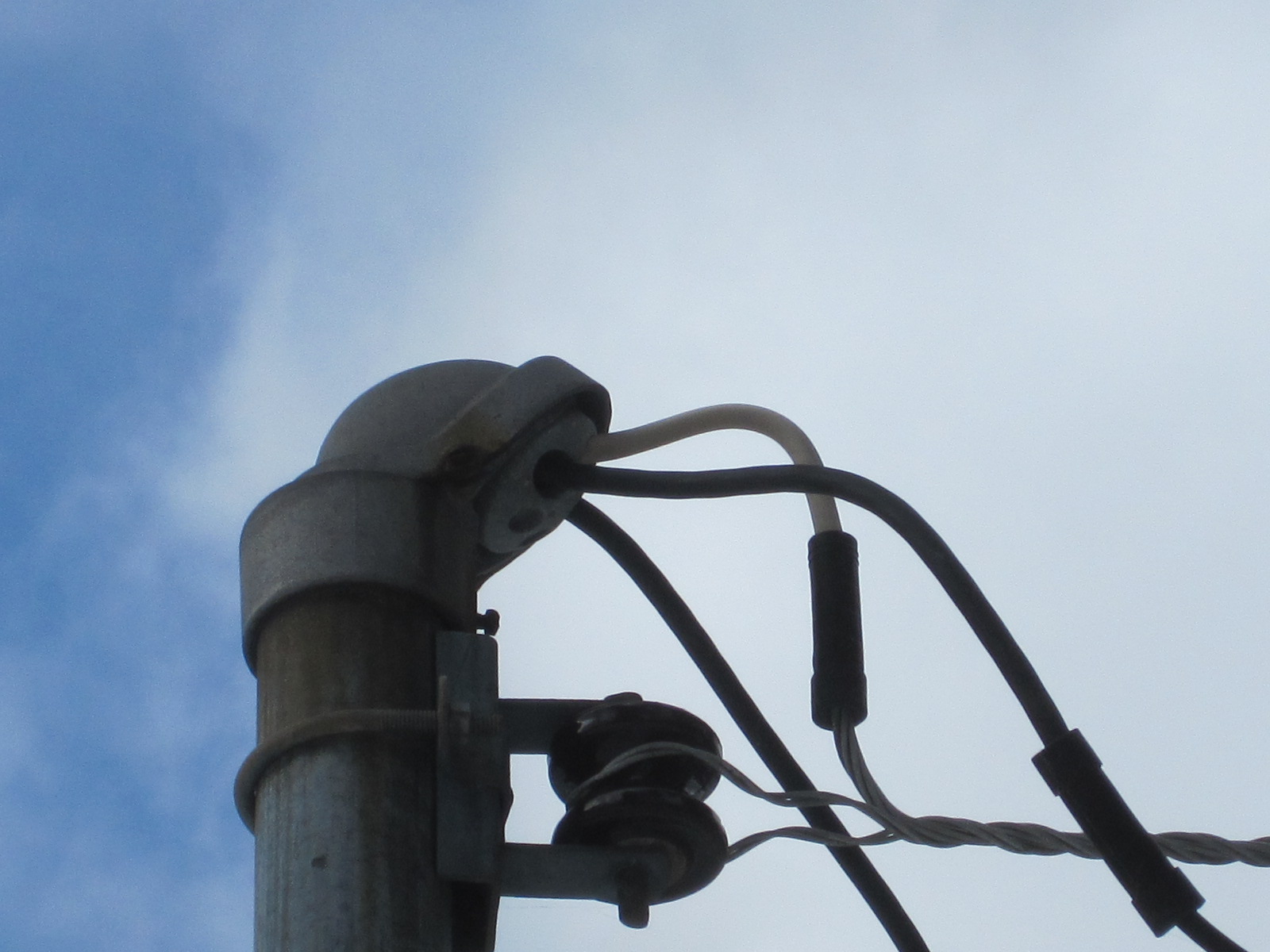
A home’s electrical system is complex, and a professional home inspector will always inspect the service connection before moving indoors to examine the main panel and other components of the system. Every overhead electrical service is required to have a drip loop in hot, neutral and ground wire. This prevents water from following wire down into mast head and eventually into your main panel.
Many times I have come across homes which have a 100 amp panel and service on the Real Estate listing but upon investigation I have had to inform the home buyer that they only have a 60 amp or less service. Some sellers will install a 100 amp rated panel but it will either only have a 60 amp breaker or it is connected to a fused switch box which is 60 amps or less. This is an important item for a purchaser as most insurance companies will not insure a cottage, never mind a residential home with less than a 100 amp service. Older homes may not even have 100 amp service from the local hydro service. The home owner would be responsible for upgrading wires to mast and service connection.
Older homes will often have knob and tube wiring as part of the homes electrical system. Once again insurance companies will often refuse to ensure a home with older knob and tube wiring installed. Unfortunately many home owners or electricians will only replace the easy to access knob and tube wiring and hope that what is remaining is not discovered. Recently I inspected a home in Georgiana Township which had the attic access from a dormer on the roof. The ceiling joists were older and under sized compared to today’s standards but there was a barely visible knob and tube circuit on the other side of the attic. I slowly ventured across the ceiling joists which moved when my weight was applied and got close enough to test the knob and tube with my electrical tester…and wow, what a surprise, there were two live knob and tube circuits and they had newer romex electrical cable being fed from them. So here we have a building where the electrical panel and lower wiring had all been updated but up in the attic out of sight someone made the decision to take a short cut!! Unless you look you just never know what you will find.
Basements are the scene of many “do it yourself” renovations. In Ontario any electrical changes or improvements requires a permit and inspection by the Electrical Safety Authority or the work must be performed by a Master Electrician who carries the proper insurance. When you go into a basement and find your typical cluster of electrical mistakes you can immediately assume that the work was not done by an electrical tradesperson or was there a building permit issued for the renovation. Some of the typical errors found are: reversed polarity on outlets; missing electrical covers; un-secured electrical cables at boxes and running across walls and ceilings.
One of the most expensive electrical repairs could be when a home owner builds a basement using steel studs and fails to use the proper grommets for insulation purposes. When you find a section of steel stud wall where the romex cable was just pulled through the holes I think it would be safe to assume the whole basement had been wired the same way. The fix for this would entail removing all the drywall to install wiring properly and in accordance with the Electrical Code in force for your area.
Aluminum wiring is another situation where insurance companies maybe reluctant to insure a property which has aluminum wiring installed. There are a lot of homes and cottages where there may have been originally aluminum in main floor installed but a later renovation was all done in copper, your insurance company may require the aluminum to be upgraded to copper prior to insuring property. Some home owners will have all the accessible aluminum wiring replaced but my attempt to hide the remaining aluminum. This is often done by using junction boxes or even as simple a subterfuge as inserting cable fully into fuse or breaker to make identification difficult. Fortunately aluminum wiring also has aluminum ground and neutral so a quick look at the neutral bar and ground connections will quickly identify any aluminum circuits. This is one of the reasons that the Barrie Home Inspector removes the cover from the main electrical panel and checks some of the visible junction boxes. This is just too expensive a problem to take a chance on information supplied by the seller.
As a home buyer you can protect yourself when purchasing a home with some minor wiring deficiencies by requesting a inspection certificate from the Electrical Safety Authority in Ontario and the Authority Having Jurisdiction in your area.
Managing Your Homes Moisture. Moisture management can be accomplished by controlling the three ways that moisture enter your home, which are: air currents; by diffusion and heat transfer. Air movements accounts for around ninety eight percent of all moisture in your home. Moisture transfer by air currents is very fast-in the range of several hundred cubic feet of air per minute. Sealing air pathways is one of the most important methods of reducing moisture in the home. Seeping through basement walls, showers and even cooking are some of the most common ways moisture can enter your home.
If you have an older home or cottage with a crawl space then seperating your crawl spaces dirt floor from your living area will drastically reduce moisture rising up and into your home. New construction is required to have this by current Building Code requirements. Ventilation of crawl space is very important during summer months.
Carpet on concrete floors can absorb moisture and serve as a place for pollutants and mould to grow. Use area rugs which can then be taken up and washed often. In climates with high humidity, if carpet is to be installed over a concrete floor, it may be necessary to use a vapor barrier (plastic sheeting) over the concrete and cover that with sub-flooring (insulation covered with plywood) to prevent a moisture problem.
Mould is everywhere and can grow on your walls, floors, appliances, carpet, or furniture. Any of these items can provide the food mold needs to grow. But the thing all molds need most is moisture, so you’re most likely to see mold in damp places such as bathrooms, kitchens, laundry rooms, basements, and crawl spaces. Use dehumidifiers and air conditioners, especially in hot, humid climates, to reduce moisture in the air. Keep indoor humidity below 60% if possible. You can measure relative humidity with a hygrometer, an inexpensive instrument available at most hardware stores.
Some simple methods of protecting your home are: Keep air conditioning drip pans clean and if using a window unit ensure moisture is draining properly. Keep the house warm in cool weather, as the temperature goes down, the air is less able to hold moisture and it condenses on cold surfaces, which can encourage mold growth. Add insulation to cold surfaces, such as exterior walls, floors, and windows to reduce condensation. Dry wet areas within 24 to 48 hours to prevent mold growth. Fix leaks and seepage. The ground should slope away from your house. If water is entering the house from the outside, your options range from simple landscaping to extensive excavation and waterproofing.
Relative Humidity is the measurement of moisture in the air. For example, according to the psychrometric chart, air at 68 F (20 C) with 0.216 ounces of water (H2O) per pound of air (14.8g H2O/kg air) has 100% RH. The same air at 59 F (15 C) reaches 100% RH with only 0.156 ounces of water per pound of air (10.7g H2O/kg air). The colder air holds about 28% less moisture than the warmer air does. The moisture that the air can no longer hold condenses on the first cold surface it encounters — the dew point. If this surface is within an exterior wall cavity, the result will be wet insulation and framing.
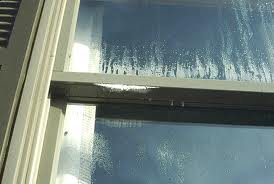
Many people complain about moisture on their windows in the winter. Excess moisture condenses on window glass because the glass is cold. Other sources of excess moisture besides overuse of a humidifier may be long showers, running water for other uses, boiling or steaming in cooking, plants, and drying clothes indoors. If you are using a humidifier then it is set too high and should be turned down.
Ventilating roofs in hot and humid conditions may add (rather than remove) moisture from attics and enclosed roof spaces. However, not ventilating roofs may void the asphalt-composition roofing manufacturer’s warranty, and slightly decrease the life expectancy of the roofing material due to increased temperature of the roof’s surface.
Roof overhangs and projections, such as porch roofs and overhanging upper floors, provide a primary means to deflect rainwater away from building walls. Thus, the potential for water penetration through siding, windows and doors is minimized. Because the protection of roof overhangs increases with increasing overhang width, larger overhangs than those recommended in this section may be important in the consideration of weather-resistant wall-barrier design.
The installation of even the most weather-resistant wall envelope system on a house does not diminish the need for proper installation, particularly with regard to flashing details at penetrations. In addition, the use of roof overhangs provides performance benefits for all cladding systems by reducing the moisture load experienced over time, and by allowing greater opportunities for walls to dry in the event of periodic wetting due to wind-driven rain. The life expectancy of various siding materials may vary widely, from 10 to as much as 100 years or more, depending on type of material, climate exposure, maintenance, and other factors.
Relying on window and door products that are labeled according to standard test methods does not necessarily guarantee that water leakage will not occur through frames into walls. Frames that rely on seals and sealants at internal and exposed joints will eventually leak water, as these joints fail over time. The life expectancy of window and door units may vary widely, from 10 to 50+ years, depending on unit type and materials, exposure, maintenance, types of seals and sealants used at joints, and other factors. Frames that rely on “welding” of joints rather than sealants will generally provide a longer moisture-resistant service life.
What Is a Home Inspection. Most home buyers will go through the home inspection process before buying their home, but there are still people who are not sure whether they really need a home inspection or not. These people typically have a relative who is a contractor or in the construction business and they are willing to rely on their expertise when making one of the most significant investments in theirs life.
Home inspections have been around for over twenty years and initially most Realtor’s did not promote using them. Realtor’s only get paid when their clients buy or sell a property so it stands to reason that anyone who may prevent that from happening would not be welcomed by most Realtor’s. This is why many people prefer to hire their own home inspector to get an un-biased opinion of the property and not the favourite go to guy that some Realtor’s may use. Some home inspectors have been known to gloss over a properties short comings to get a Realtor’s business. The Realtor’s code of ethics requires them to refer a minimum of three home inspectors to their client for this very reason.
These are some of the many reasons why a home inspection is considered as an advantage for home buyers:
It really does reveal much
Home inspection will give you a clear perspective of the property you are interested to buy. Some of the most important matters that are revealed during a home inspection are: serious property issues, possible repair needs, safety assessment, air system and ventilation quality, quality of walls and floors, electrical wiring, drainage etc.
Shop around and find a Professional
Different home inspection services charge differently: by square foot, by hour or by a general assessment on the house. Shop around and find out what the price includes as almost every company works differently. The more established home inspection companies offer Free Thermal Imaging as part of the home inspection package. Thermal Imaging can detect hidden moisture, hot spots in electrical wiring and fixtures and it can also find areas of missing insulation. Professional home inspectors are also WETT certified which is important if you have a wood burning appliance as your insurance company will require an inspection by a Wett Certified Professional.
It only takes a few hours
How long a home inspection takes usually will depend mainly on the size of the home. Usually, an average home inspection takes about 2-3 hours, but there are also big houses that require more time in order the inspection to be conducted properly. Century homes will typically take longer as there are more issues such as knob & tube wiring, galvanized plumbing, asbestos insulation and structural considerations to evaluate. Most professionals inspectors will charge $50.00 more for inspecting this type of home.
The Results are 98% true
When buying a home you have to remember that home inspection does not provide a guarantee that a house is free from defects. It only reports what is visible at the time of the inspection. Although we have all seen Mike Holmes go into a home and start pulling down walls etc. you have to remember that the property is still owned by someone else and you or the home inspector do not have permission to do any damage to the property. A home inspection can not protect you from a home owner who deliberately hides a deficiency or symptom of a deficiency by covering or painting to prevent discovery. Always ensure your Realtor has a Seller Property Information Sheet filled out which can protect you if it is discovered that the seller did if fact hide a deficiency which would have prevented you from buying the home if you had known. A Certified Master Inspector will have performed a minimum of 1,000 inspections and had a background check.
Ask an E&O Insurance Pro: FAQs about Pre-Inspection Agreement. When beginning to work with an insurance program specifically for home inspectors, it can sometimes be difficult to fully understand all of the processes and risks that can come into play during an inspection. To help educate to reduce these risks, we’ve compiled a couple of our most frequently asked questions.
One of the large areas of discussion for E&O insurance is what’s referred to as the Pre-Inspection Agreement, as well as what protections are offers to inspector. Below are a couple of the most commonly asked questions about inspection agreements:
What Should my Home Inspection Agreement Include?
This is another question that doesn’t have an easy question. The best way to figure out what your agreement should include is to look at examples. Many inspection organizations provide agreement templates or examples. These references are a fantastic resource, and have been utilized successfully by countless inspectors. Remember though, do not plagiarize. These examples are guidelines, if you haven’t received written permission, or if you are not a member of the organization or association, lifting this content is a big no-no.
There are a couple things to look for when creating your inspection agreement. Aspects such as a Limit of Liability, as well as an Environmental Hazards clause are necessary additions, even if the state provides some protection from these liabilities. These state protection cases are usually only based on the most rudimentary definition of inspections, so there is only a small window where these cases fit in.
What is the Ideal Length for my Home Inspection Agreement Contacts?
Depending on how you look at it, there’s no right or wrong answer here. There are countless styles and different types of home inspection contracts, you have to figure out what best fits your business model. I have seen great contracts that total a single page in length, and I’ve seen very comprehensive contracts that itemize each and every detail. It all comes down to what will help the client understand the agreement best, and will protect you in the process. The main thing that needs to be expressly details is what a visual-only home inspection involves. Overall, it comes down to what you feel protects your business, and the customer best.
Does Every Client Have to Sign Their Inspection Agreement? Even if they’re Moving or Aren’t Local?
The short answer is yes. To expand on this, it’s crucial that each client signs off on their inspection agreement. Keep in mind that if a client is no longer local or available to sign the contact in person, they very well could not have looked at the home in person. This then means that they are entrusting you to detail what to expect when they move into the house. It also entails that they will have less of a familiarity with the property, as you could potentially be the first person they contact.
It is worth the time and effort to acquire a signed agreement (an emailed or faxed copy works). This will provide you the additional protection needed to ensure that the client knows what a visual inspection involves. Many home inspectors have enlisted the help of an eSignature option to make the process easier for their clients. This lets their clients the opportunity to log-in, sign and verify the document without needing to jump through additional hoops.
Can a Client’s Realtor Sign the Home Inspection Agreement by Proxy?
No, under no circumstances is that legal. Make sure that this is clear, and don’t consent to any Realtor signed proxy agreements. Remember who you’re providing the service for, most likely it is for a particular client, and not the realtor. Although it is great to create a good working relationship with local Realtors as you build your business, they are not the client, and cannot sign for them by proxy.
This is all about risk management and protection, as you would be the one paying for it if a claim was ever filed. Typically, smart and seasoned Realtors know this, and will help you acquire the true client’s signature. Remember, this isn’t a restaurant, we don’t do substitutions.
Why Should I Get Insurance if I Already Have an Inspection Agreement?
Like in most other industries, many professionals don’t feel insurance is something they need. We’ve constantly heard professionals state that their inspection agreement is bullet-proof, while means that there’s no need for insurance.
Granted, if you’re located in an area that requires E&O insurance, this doesn’t really apply to you. However, for those still living in the Wild West, remember that insurance is protection for “what if?” It is smart business to invest in as much protection as you can to ensure your business can weather any proverbial storm. Within the world of home inspection, an inspection agreement the first and last line of defense against filed claims. Claims happen to every inspector, it isn’t a matter of if, but more a matter of when, and it only requires one to change the trajectory of your business.
Byline: Derrick Slouman is a contributor for EiiPro and EliteMGA, a US company specializing in errors and omissions insurance. For more information on E&O insurance, and to see what options are available to you, visit EiiPro and EliteMGA on the web today at www.eiipro.com.
When you hire a home inspector to perform a home inspection you usually will be asked to read and sign a Pre-Inspection agreement which states what a home inspector is and is not responsible for inspecting. This is a standard boiler plate type of document that is typically modified to suit each inspectors qualifications and experience. In the pre-inspection agreement there is usually a reference to the Standards of Practice for the organization that that particular home inspector belongs to. View Barrie Home Inspector’s Standards of Practice
A home inspection is a limited, non-invasive examination of the condition of a home, often in connection with the sale of that home. Home inspections are usually conducted by a home inspector who has the training and certifications to perform such inspections. The inspector prepares and delivers to the client a written report of findings. The client then uses the knowledge gained to make informed decisions about their pending real estate purchase. The home inspector describes the condition of the home at the time of inspection but does not guarantee future condition, efficiency, or life expectancy of systems or components.
NACHI (National Association of Certified Home Inspectors) Standards of Practice states, ” A general home inspection is a non-invasive, visual examination of the accessible areas of a residential property (as delineated below), performed for a fee, which is designed to identify defects within specific systems and components defined by these Standards that are both observed and deemed material by the inspector. The scope of work may be modified by the Client and Inspector prior to the inspection process. The general home inspection is based on the observations made on the date of the inspection, and not a prediction of future conditions. The general home inspection will not reveal every issue that exists or ever could exist, but only those material defects observed on the date of the inspection.
The typical Standard of Practice places Limitations, Exceptions and Exclusions on the Home Inspection. Some of the most important ones of note are: Asbestos, Radon, Formaldehyde, Wood Destroying Organisms, Rodents and Lead. There are many more but the list is pretty exhaustive.
The home inspection report will list items that are defective or in need of service or maintenance. The Barrie Home Inspector includes a picture of every item that requires service, maintenance or replacement in the home inspection report. Ensuring the client understands the importance of any particular deficiency is just as important as noting the deficiency.
Many clients want a repair estimate on any item that is noted as being defective in the home inspection report. Most home inspectors will not give a firm estimate on any repair cost due to the fluctuation of labor rates between service personnel. It would be impossible to quote the cost of service call when you do not know the per hour rate and even how fast that particular tradesperson performs his tasks. Some home buyers may want to request that the home seller repair some deficiencies prior to completing the sale. While this may look good on paper a buyer would be better served to get an estimate from a qualified person and negotiate that cost from the sale price, as the home owner may just hire the cheapest person to make repair. It is better to hire your own individual and even supervise repair to ensure it is done to your satisfaction.
SPIS (Seller Property Information Statement) is one of the best ways homebuyers can protect themselves from buying a house that has known issues, such as flooding when it rains hard or hidden moisture in the walls. While a SPIS is not required for the sale of a home, OREA considers including one with the listing is good practice. A seller can be held responsible for issues found after the sale of the home if they did not disclose an issue that was not visible or found during a home inspection. Read more about SPIS
Your Realtor is also bound by their Code of Ethics to disclose any concern that they are aware of. To find out more info on SPIS and Realtors visit the Barrie Home Inspector.
Attending the Home Inspection is the best advice any Home Inspector can give you. Following your Home Inspector as he inspects and explains what he is looking at is valuable knowledge about your new home. You will learn about all the major systems of your home and any potential areas where maintenance is required. Attending the inspection and having a fully documented home inspection report will allow you to make any required repairs and identify areas where you should be providing the required maintenance to keep your home in good condition.
Many times at a home inspection the sellers will leave out their previous home inspection report for review. The majority of maintenance defects noted in the home inspection report will typically not have been repaired. This is really a waste of a valuable resource and home owners should take advantage of the expertise and knowledge of their home inspector and repair any listed deficiencies.
SPIS – Protection for Homebuyers. Barbara Sukkau, president of OREA, advises that one of the best ways homebuyers can protect themselves is to ask for a Seller Property Information Statement (SPIS) from the homeowners. “An information statement like the SPIS will tell potential buyers what the known issues are in the house—both those you can easily see and those that are hidden behind walls or only appear after something like a heavy rain or snowstorm,” says Sukkau.
While providing a SPIS for a house is not legally required by a seller, it is considered a best practice by OREA, and Realtors will encourage sellers to include one with the house’s listing. OREA also instructs Realtors that disclosure is imperative as prescribed in their Codes of Ethics. “We recommend listing everything that a buyer might be concerned about in the home because, as Realtors, we are trained to work within the rules of real estate law and are familiar with recent court judgements against sellers who failed to inform a buyer about the home’s history,” says Sukkau.
An information document like the SPIS is not a warranty, but it can help protect the buyer or the seller if the buyer discovers an issue with the house after the sale and wants money to fix the problem or takes the previous owner to court. The SPIS shows the seller acted in good faith and told the buyer about all the known issues.
In Ontario, caveat emptor or “buyer beware” applies to real estate law. A homeowner selling his or her property may believe that it prevents litigation if the buyer later discovers a problem with the property; however, this is not actually what caveat emptor means. “Buyer beware” means that the buyer cannot after the sale is closed ask the seller to pay for repairing something on the property if the problem was visible at the time of purchase or could be discovered through a home inspection. For example, if the buyer sees that a window is broken in the home, he or she cannot later ask for money to repair it, but the buyer could ask their Realtor to include a clause in the agreement of purchase and sale to fix the window before the sale is finalized.
On the other hand, the seller is legally obligated to inform the buyer of any problems that would not be discovered during a home inspection (e.g. a basement that floods after a heavy rainfall) as this is a latent, or hidden, defect. If the seller did not tell the buyer about the problem before the sale is finalized, the buyer could take the previous owner to court for failure to disclose the dangers if it can be proven that the sellers knew about the issue when the home was sold.
“Some homeowners may be reluctant to tell a potential buyer that the basement leaks or if there is old wiring, but providing this information can make your house more attractive to buyers than sellers who do not provide a list. People interested in your home will know what to expect and will not have to worry about having unhappy surprises after they move in,” says Sukkau.
The use of Disclosure Statements is mandatory in some places, but in Ontario, and elsewhere in Canada, they are voluntary although “strongly recommended” by real estate agents. At theThunder Bay Real Estate Board Level, the SPIS, which is published by the Ontario Real Estate Association (OREA), is mandatory. If the statement is not submitted to the board within 48 hours of listing a house, the Board will pull the listing from MLS until it is submitted. The SPIS can be crossed out and shown “As Is”, but must be signed by the seller.
The questions in the SPIS may require complex answers and many lay people may not understand the questions. It is arguable the SPIS asks sellers to disclose more than they are required to do by the law. A problem with the forms for Real Estate Agents is that if the seller gets sued, then the agent may be joined in the action for their role in using/preparing the forms
“Real estate agents are not lawyers and should not be expected to provide legal advice. The practical reality, however, is that many individuals in real estate transactions likely rely on their real estate agent for legal advice.” Lyle v. Burdess, YK, 2008”.
The vast majority of residential real estate transactions close as scheduled, without problems or disputes. Some lawyers argue that the chances of any given real estate deal resulting in litigation involving the buyers, sellers and real estate agents increase when the agents insist that the sellers complete a SPIS. On the other hand, many experienced Agents argue that the use of SPIS has eliminated much litigation, and creates certainty for the information given to the buyer.
The object of this paper is to clarify the use of the SPIS and explain how the courts interpret the SPIS.
WHAT MUST A VENDOR DISCLOSE?
Before there ever was an SPIS, the Doctrine of Caveat Emptor (“Buyer Beware”) applied. Absent fraud, mistake or misrepresentation, a purchaser would take an existing property as he found it, whether it was decrepit, bug-infested or otherwise uninhabitable, unless he/she protected himself by contract terms.
The current law is that a vendor is not under a duty to disclose patent defects of quality; however they have an obligation disclose latent defects which render the property unfit for habitation or defects which render the property dangerous or likely to be dangerous. There is no duty to disclose defects which affect the value (only) of the lands. There is an obligation to disclose habitation or dangerous deficiencies discovered after the Agreement is signed but before closing. Nonetheless, vendors are not liable if they have no knowledge of the latent defect.
From a consumer protection standpoint a move away from the harshness of caveat emptor to a full disclosure model is defensible. Many agents argue that by reducing the representations to writing there is less likelihood that the answers will be misinterpreted. As several agents have noted – if the Vendors won’t complete the Disclosure Statement, we wonder what they are trying to hide?
CRITICISMS OF USING AN SPIS
• Disclosure Statements require Vendors to disclose more information than a Vendor would normally have to disclose.
• The average layperson probably doesn’t understand many of the questions let alone know the correct answers.
• They may be seen as an attempt to protect the real estate agents.
• They offer more protection to the vendor, than the purchaser.
• It does not directly disclose the actual condition of the property. It requires the vendor to say no more than that he or she is not aware of problems.
• Places buyers in an advantageous bargaining position being armed as they are with a list of all known defects, patent and latent.
REVIEWING THE SPIS
The following are some of the sections or paragraphs from the SPIS Form 220. The bullet points after them are commentary on the same.
“ANSWERS MUST BE COMPLETE AND ACCURATE This statement is designed in part to protect Sellers by establishing that correct information concerning the property is being provided to buyers. All of the information contained herein is provided by the Sellers to the broker/sales representative. Any person who is in receipt of and utilizes this Statement acknowledges and agrees that the information is being provided for information purposes only and is not a warranty as to the matters recited hereinafter even if attached to an Agreement of Purchase and Sale. The broker/sales representative shall not be held responsible for the accuracy of any information contained herein.”
• A CRITICISM OF SPIS FORMS MAY BE MORE FOR THE PROTECTION OF THE AGENT – IS THIS LIKELY TO PROTECT YOU IF THEY ASK YOU HOW TO FILL IN THE FORM, AND THE ADVICE IS WRONG!
• THE OTHER SIDE OF THIS CRITICISM IS THE FACT THAT:
o (a) nobody knows the property (and especially the latent defects) better than the owner/vendor;
o (b) owners/vendors sometimes hide latent defects from their agents; and
o (c) if the roof leaks or the well goes dry the broker and the agent often get sued along with the vendors – for
“discovery” if nothing else.
“BUYERS MUST STILL MAKE THEIR OWN ENQUIRIES Buyers must still make their own enquiries notwithstanding the information contained on this statement. Each question and answer must be considered and where necessary, keeping in mind that the Sellers’ knowledge of the property may be incomplete, additional information can be requested from the Sellers or from an independent source such as the municipality. Buyers can hire an independent inspector to examine the property to determine whether defects exist and to provide an estimate of the cost of repairing problems that have been identified. This statement does not provide information on psychological stigmas that may be associated with a property.”
• THIS IS TO TRY AND SHOW THE BUYER KNEW THEY MUST DO THEIR OWN INVESTIGATION.
“General:” Section
• When answering the questions, they must be filled out by the seller (not the agent). Agents must ensure that the seller initials every box, as this will prevent agents from being accused of incorrectly filling out the SPIS on behalf of the seller, and then having the seller sign them, and the agent later being held liable in Court.
“2) Does any other party have an ownership, spousal or other interest in the property?”
• MANY PEOPLE DON’T REALIZE THAT A SPOUSE CAN HAVE A POSSESSORY INTEREST EVEN THOUGH THEY ARE NOT ON TITLE
“5) Are there any encroachments, registered easements, or rights of way?”
• TO DISCOVER ANY ENCROACHMENTS, A SURVEY OF THE PROPERTY MIGHT HAVE TO BE DONE. MANY OWNERS WOULD NOT KNOW ABOUT RIGHTS OF WAY, AS THESE COULD BE SUCH THINGS AS AN UNREGISTERED EASEMENT (FOR EXAMPLE, HYDRO MAY HAVE AN UNREGISTERED EASEMENT FOR OVERHEAD POWER LINES)
“8) What is the zoning on the subject property?”
• TO KNOW THIS ANSWER, THE OWNER MAY NEED TO SEE THE ZONING MAP FOR THE CITY
“9) Is it legal non-conforming (if it does not comply with zoning)?”
• MOST PEOPLE DO NOT KNOW WHAT THIS MEANS, LET ALONE THE ANSWER.
“11) Are there any restrictive covenants that run with the land?”
• MOST SELLERS DON’T KNOW.
“12) Are there any drainage restrictions?”
• THE SUBDIVISION AGREEMENT WITH THE CITY RESTRICTS CHANGES IN GRADE.
“13) Are there any local levies or unusual taxes being charged at the present time or contemplated?”
• THIS IS AN EXAMPLE OF HOW VENDORS HAVE TO DISCLOSE MORE THAN THEY WOULD NORMALLY HAVE TO DISCLOSE
“16) Is the property connected to municipal water and sewer?”
• IF NOT, FORM 222 MUST BE COMPLETED.
The following are the relevant paragraphs from Form 222:
Form 222:
1. (c) are you aware of any problem re: quantity of water?”
• CURRENT ACTUAL KNOWLEDGE – MUST YOU DISCLOSE PROBLEMS IN PRIOR YEARS.
“(d) are you aware of any problems re: quality of water?”
• IN THE PAST WERE THERE WATER SAMPLES THAT FAILED?
“21) Are there any past or pending claims under the Ontario New Warranty Program?”
• IS THIS JUST WHILE THE SELLER OWNED THE PROPERTY?
Form 220, Continued:
ENVIRONMENTAL
“3) Is the property subject to flooding?”
• DOES ONE FLOOD MEAN ITS S.T. FLOODING? DOES ‘PROPERTY’ MEAN THE WHOLE PROPERTY OR JUST THE HOUSE?
“4) Is the property under the jurisdiction of any Conservation Authority or Commission?”
• THIS IS ANOTHER EXAMPLE OF HOW VENDORS HAVE TO DISCLOSE MORE THAN THEY WOULD HAVE HAD TO DISCLOSE BEFORE THESE SHEETS WERE MANDATORY. DOES THE SELLER HAVE THIS KNOWLEDGE?
IMPROVEMENTS AND STRUCTURAL:
“7) Are you aware of any moisture and/or water problems?”
• DOES “ANY” MEAN YOU HAVE TO DISCLOSE A LEAK THAT WAS FIXED? I.E. ROOF? BASEMENT?
“12) Is there any lead, or galvanized metal plumbing on the property?”
• IF THE SELLER DIDN’T BUILD, HOW DO THEY KNOW WHAT PLUMBING THERE IS.
Bottom of Page 2 of Form 222
“THE SELLERS STATE THAT THE ABOVE INFORMATION IS TRUE, BASED ON THEIR CURRENT ACTUAL KNOWLEDGE AS OF THE DATE BELOW. ANY IMPORTANT CHANGES TO THIS INFORMATION KNOWN TO THE SELLERS WILL BE DISCLOSED BY THE SELLERS PRIOR TO CLOSING. SELLERS ARE RESPONSIBLE FOR THE ACCURACY OF ALL ANSWERS. SELLERS FURTHER AGREE TO INDEMNIFY AND HOLD THE BROKER HARMLESS FROM ANY LIABILITY INCURRED AS A RESULT OF ANY BUYER RELYING ON THIS INFORMATION. THE SELLERS HEREBY AUTHORIZE THAT A COPY OF THIS SELLER PROPERTY INFORMATION STATEMENT BE DELIVERED BY THEIR AGENT OR REPRESENTATIVE TO PROSPECTIVE BUYERS OR THEIR AGENTS OR REPRESENTATIVES. THE SELLERS HEREBY ACKNOWLEGE RECEIPT OF A TRUE COPY OF THIS STATEMENT.”
• CURRENT ACTUAL KNOWLEDGE – ATTEMPT TO LIMIT NEED TO MAKE INQUIRIES BY SELLER;
• IMPORTANT THAT YOU LET THE SELLERS KNOW THAT IF SOMETHING COMES UP AFTER THE AGREEMENT OF PURCHASE AND SALE, THAT THEY HAVE TO DISCLOSE PRIOR TO CLOSING – IN WRITING PREFERABLE
• THIS IS AN ATTEMPT TO PROTECT AGENTS – “INDEMNITY”
RELEVANT CLAUSES OF AGREEMENT OF PURCHASE AND SALE
“13. INSPECTION: Buyer acknowledges having had the opportunity to inspect
the property and understands that upon acceptance of this Offer there shall be a binding agreement of purchase and sale between Buyer and Seller. The Buyer acknowledges having the opportunity to include a requirement for a property inspection report in this Agreement and agrees that except as may be specifically provided for in this Agreement, the Buyer will not be obtaining a property inspection or property inspection report regarding the property.”
“24. AGREEMENT IN WRITING: If there is conflict or discrepancy between
any provision added to this Agreement (including any Schedule attached hereto) and any provision in the standard pre-set portion hereof, the added provision shall supersede the standard pre-set provision to the extent of such conflict or discrepancy. This Agreement including any Schedule attached hereto, shall constitute the entire Agreement between Buyer and Seller. There is no representation, warranty, collateral agreement or condition, which affects this Agreement other than as expressed herein. For the purposes of this Agreement, Seller means vendor and Buyer means purchaser. This Agreement shall be read with all changes of gender or number required by the context.”
Cheadles – Lawyers & Trademark Agents states the following:
REPRESENTATIONS AND WARRANTIES
One of the questions which the courts have been wrestling with is whether the statements contained in the “SPSI” or disclosure statements are representations or warranties. The third sentence in the first paragraph of the OREA form states that “The information is being provided for information purposes only and is not a warranty”.
A warranty is a statement collateral to the contract. Breach of a warranty entitles the purchaser to damages only and does not permit the purchaser to rescind the contract. A representation is a statement made by one party to the other, before or at the time of contracting, regarding some existing fact, or some past event, which is one of the causes that induces a contract.
In Ward v. Smith (2001) 45 R.P.R. (3d) 154 the B.C. Supreme Court adopted the following descriptions of disclosure statements:
“The purpose of the disclosure statement is to raise questions and concerns rather than give detailed answers to the disclosures made.”
“Although the property condition disclosure statement forms part of the agreement for a purchase and sale, it is not necessarily a warranty. Its main purpose is to put purchasers on notice with respect to known problems. The disclosure statement … merely indicates that the statements therein are true according to the seller’s current actual knowledge.”
“The disclosure statement does not call upon a vendor to warrant a certain state of affairs. It requires the vendor to say no more than that he or she is or is not aware of problems”.
The Court also stated “Representations are non-contractual. If they are not true, the appropriate remedy is not an action for breach of contract, but the avoidance or rescission of a contract entered into in consequence of the representation, and, possibly, a tort action for damages. Thus…. a misrepresentation, may:
(a) entitle the representee to avoid the contract, if the representation was fraudulently made;
(b) entitle the representee to rescind the contract, if the representation was innocently made or;
(c) entitle the representee to sue, in tort, for damages if the representation was negligently made”.
Therefore, it is clear that the statements made in the SPIS are not a warranty, but the court will consider them a representation. Depending on whether the representation was fraudulent, innocent, or negligent will determine the remedy of the buyer. The next two cases show that sellers must be very cautious in filling out the SPIS, because the courts will not hesitate to make sellers pay for a representation that turns out to be false.