Every new home constructed is required to go through a rigorous design process, which normally includes a plan of subdivision. The plan of sub division is the proposed layout of all roads, sidewalks, ditches and more importantly to home owners,storm water control and hydro geological study. This initial study should ensure when you buy your new home that your basement should not be affected by pooling water or unusual drainage issues.
Your municipality or city Building Department is required under the Ontario Building Code to perform mandatory inspections of your new home. Your Building Department is paid for these inspections by fees levied by issuing a Building Permit. A list of what is typically required to be inspected follows, also included are the common issues I have found when inspecting this various items during a home inspection or experienced when building homes:
Footing – Footing are to be constructed on undisturbed soil or soil that has been compacted. If ground is “deemed” to be wet then footing size is doubled.
Back Fill – Only clean fill is supposed to be used to backfill your foundation. Many builders will bury building debris while back filling foundation.
Framing – Joist hangers are supposed to be completely nailed ( all holes used ) using “rated nails” which usually are stamped on nail head.
HVAC Rough in – Substantial completion of ductwork and piping.
Insulation – Completion of insulation and vapour barrier. Many times trades will remove insulation and vapour barrier and neglect to replace when job is completed. Attic insulation is often not installed evenly and areas of low insulation can exist.
Fire Separations – Many times drywall tape is falling off seams due to poor installation.
Water Supply and Plumbing – Some plumbers will install clean out above floor grade creating a trip hazard.
Final Interior Inspection – Doors, windows, floors, walls, ceilings and fixtures are inspected.
Final Exterior Inspection – This is where many times I find new homes with no Ice or Water Shield installed under shingles. The roofer saves himself $300 to $500.00 in materials because he knows the inspector will not go up to the second floor on a ladder and check shingle installation.
Occupancy Permit is Issued.
Personally I think any time you find a issue in your new home that should have been caught by your local Building Department, you should contact them to ask for re-inspection. They are specifically trained to inspect the construction of your home and legally not permitted to inspect any construction beyond the scope of their learning. As a home buyer you pay for the cost of these inspections and as the end user should expect your home to be free of obvious defects.
Buying older Homes
When you buy an older home that has been renovated you should ensure all work was done with a Building Permit and the proper inspections were completed. If you purchase a home that has been renovated and no permit was issued, you will then assume responsibility for any subsequent work that may be required to bring your home up to the required standards. This can be particularly expensive if structural, plumbing or electrical work is involved.
When you require a WETT Inspection in Alliston or New Tecumseth, call the Alliston Home Inspector for prompt and experienced service. Over tens years as Certified WETT Inspector and over 5,000 home inspections ensures your investment is protected when purchasing a new home.
Save Money when Obtaining a WETT Certificate as part of Home Inspection package. Only $75.00 when included with Home Inspection.
WETT inspection is a visual inspection of a wood-burning appliance to help ensure the appliance is safe and complies to the current building code requirements (BC365). WETT inspections are commonly requested by real-estate agents during a home sale or purchase and home owners when requested by their insurance companies.
Wood Energy Technology Transfer (WETT) is the authority on all solid fuel burning appliances in Canada. The Canadian Standards Authority (CSA) recognizes the Standard B365 as the guide lines to ensure the safe and proper installation of all wood stoves, pellet stoves, factory built fire places, combination furnaces and add-on furnaces.
Some Common Questions Asked by WETT Inspection Clients
WHAT ARE CLEARANCES?
Clearances represent the minimum distance that a woodburning appliance can be installed from anything that could overheat and potentially burn. During normal operation, the outer surface of a wood burning stove reaches temperatures around 300°C (570°F). At peak output, it can reach temperatures as high as 540°C (1000°F).
If combustible materials are located too close to the stove, they could ignite and cause a house fire. The closer you are to a fire, the more intense the heat. Clearances are designed to keep combustible materials around a (190°F), even in the event of a chimney fire.
Wood exposed to temperatures as low as 120°C (250°F) over a pro-longed period of time will begin to char and may ultimately ignite. The highest temperature to which combustibles can safely be exposed for long periods is 90°C (190°F).
WHAT’S A “COMBUSTIBLE”‘?
A combustible is anything that will burn, including wallpaper, wood studs, certain types of insulation (e.g., polystyrene) and paneling. Even so – called “fire resistant” gypsum board (drywall) panels are considered combustible. According to the Building Code any product that does not have a fire-resistant rating is considered a combustible.
WHAT CAN FAIL MY WETT INSPECTION?
Many items can cause your WETT Inspection to fail to meet recognized standards. Some common items are:
Cracked and damaged flue tiles.
Dampers seized and in-operable
Failure to meet required distances to combustibles
Improper wall and ceiling connectors.
There are many more items that you may be required to fix or repair prior to obtaining a WETT certificate that an insurance company will accept. Call Roger to discuss your installation or concerns regarding WETT inspections for Fireplaces, Wood Stoves, Hearth Mount Stoves and Pellet Stoves.
Do you require a basic visual inspection such as for insurance or pre-purchase of a home equipped with a wood burning appliance or fireplace? A basic visual inspection is a general overview of the readily accessible parts to determine if the system meets current regulations. If this description fits your needs call today and book your
Certified WETT Inspection.
The attic is usually the last place to visit during your home inspection. Sometimes just entering the attic is a chore itself and sometimes not even possible. Some home owners will renovate a home and during the process cover up the attic access. This happens more often than you would think and prevents the buyer from knowing the true condition of the attic.
The most common deficiency that I come across in attics is the presence of rodents. Homes that have fiberglass insulation will typically have a varied level of mice infestation in their attic. Rodent proofing your attic will take some time and dedication to the task. Seal all holes and cracks with steel mesh and / or caulking, do not use plastics, rubber or wood that can be chewed. Use traps placed near entry points and empty traps frequently.
Many home owners or contractors will enter an attic to install alarm wiring, cable or to install a ceiling fan. When inspecting the attic there are many times where a trail is visible where individual has walked or crawled along the rafters compacting the insulation. In fiberglass, and most types of insulation, the air trapped between fibers is what gives an insulation factor to product. When insulation is compacted the R value is reduced and you create an area of heat loss in your attic.
Many attics are built using engineered wood trusses. Engineered trusses are designed to support a roof and the normal snow load for your area. If you hang a storage unit from an engineered wood truss you are technically required to have an engineer or designer produce a detail of proposed construction and having drawing stamped. Because the truss is an engineered product it comes under Part 4 of the Ontario Building Code regulations.
Soffit venting is probably the most important factor in preventing ices dams and allowing proper ventilation of your attic. The average roof requires 1 square foot of ventilation for every 300 square feet of roof, low slope roofs require 1 square foot for every 150 square feet of roof. The vents must be 25% on bottom and 25% on peak of roof with the remaining installed where required. It is considered a good construction practice to install upper vents on same side of roof so that air does not just cross over from one vent to the other. Soffit baffles are required to be installed at the eave of the roof to allow air from vented soffit to enter attic. Most subdivision homes will have a soffit vent installed in every third rafter bay.
Many older homes will have vents discharging into attic. Plumbing vents, bathroom exhaust fans and kitchen range exhausts should all ventilate to exterior of house. Newer homes are required to have a insulated wrap installed on exhaust ducts to prevent warm air condensing in attic and forming ice and potential blockage in winter.
Failing to properly ventilate your attic can allow moisture to build up and will eventually cause mould and damage to your sheathing and shingles. Over the years the required insulation for homes has changed. Newer homes will typically have R-50 of insulation installed. If you have an older home your insulation may require upgrading and your ventilation checked to ensure it is adequate.
Contact Barrie Home Inspector for more information or details.
DIY Electrical Projects
Many home owners like to install electrical equipment and wiring. As a Professional Home Inspector I would like to list some of the common mistakes that I encounter when inspecting homes in the Barrie ON area. Note: Although a home owner is allowed to install his own electrical wiring, they are required to take out a permit and have installation inspected by the ESA.
Many home owners use metal stud walls in basements, which require special grommets or standoffs when installing electrical cables. Metal studs on basement exterior walls is not a good ideas as metal conducts heat and cold extremely well and can also cause moisture issues due to humidity in air contacting cold areas created by conduction of cold through metal studs.
Most custom builders will use the mould proof treated wood studs when framing in basements. Pressure treated lumber is recommended for sill plate with a moisture barrier between concrete and wood required by building code.
Junction Boxes
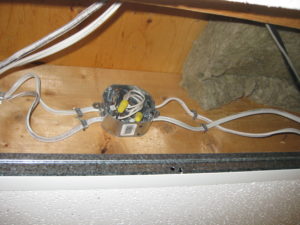
Ontario codes 12-3016(1) and 12-112(3) specify that all junction boxes must remain accessible. Junction boxes also require a cover plate to be installed.
Kitchen Installations
Kitchens require at least 2 15 amp multi-wire (split receptacles) or 20 Amp (T Slot receptacles) branch circuits to supply receptacles located along the kitchen counter work surface.
210.52(B)(1)
(1) Wall Counter top Spaces. A receptacle outlet shall be installed at each wall countertop space that is 300 mm (12 in.) or wider. Receptacle outlets shall be installed so that no point along the wall line is more than 600 mm (24 in.) measured horizontally from a receptacle outlet in
that space.
Exception: Receptacle outlets shall not be required on a wall directly behind a range, counter-mounted cooking unit, or sink in the installation described in Figure 210.52(C)(1).
This also includes the requirement for kitchen islands to have an outlet installed.
Ontario electrical code requires a dedicated electrical outlet to be located behind fridge location. This circuit is allowed to provide power to a clock also.
GFCI ( Ground Fault Circuit Interrupter)
Exterior receptacles within 8ft (2.5m) of finished grade (since 1975).
Bathroom & washroom receptacles (since 1986).
Receptacles within 5ft (1.5m) of all sinks (since 2006).
Hydro massage bathtubs must be GFCI protected.
Spas and hot tubs must be GFCI protected.
Receptacles, equipment, and buildings around pools have numerous requirements.
Metal Stud Wall Installation
The Ontario Electrical Safety Code requires that metal stud partitions be bonded to
ground so that the branch circuit over current device will operate in the event the studs become energized.
Securing Cable at Boxes
The electrical cable is required to be secured within 8” to 12” of box with a wire staple. Also you must have a 12” loop of unbroken cable on the outside of box or 6” of cable end available on the interior side of finished wall to permit replacement without major reconstruction.
Extension Cords
Flexible extension cords must never take the place of permanent wiring; they are not designed or intended for permanent installations. Once the task has been completed, the cord should always be disconnected and properly stored away for future use.
Protection of Electrical Cables
Electrical cable should be protected against mechanical damage where it passes through floors or on the surface of walls in exposed locations under 5 feet from the floor.
If burying an electrical cable you should call the ESA and find out the exact requirements for your particular location. The area where cable is buried determines depth and protection required
Dedicated Circuits
These are some of the most common items that require a dedicated electrical circuit for:
Fridge
Range or stove
Cook top
Water Heater
Heat/Air Conditioning
Dishwasher
Clothes Washer
Clothes Dryer
Furnace
Exterior lights and Outlets
Renovations without a Building Permit
The major concern when performing a home inspection and these deficiencies are noted is the fact that you now know that the work was done without a permit and that would most likely apply to all the work done by homeowner.
Why some Homeowners are using Fake Grass
Rules for Secondary Suites in Barrie
Why You Need a Home Inspection
As always, CAVEAT EMPTOR – BUYER BEWARE
An Educated Consumer is a Smart Consumer
What is mould?
Moulds are microscopic fungi; a group of organisms which also includes mushrooms and yeasts. Mould is a fungi that lives on plant and animal matter. It thrives in damp and poorly ventilated areas and reproduces by making spores.. There are over 270 species of mould have been identified as living in Canadian homes.
When is Mould a Problem?
Mould needs moisture, heat and protein to grow. Water leaks in your home can provide moisture from outside the home, through the floor, walls or roof; or from plumbing leaks. . Water enters the building when there is a penetration or failure in the structure. Moisture accumulates within the home when there is not enough ventilation or fresh air to remove moisture. Mould can be any colour, some common colours are black, white, red, orange, yellow or blue. Damage to materials is one concern of having mould – i.e. stains or discolouration; however, continued mould growth can be indicative of moisture conditions that are conducive for growth of fungi that cause wood rot and structural damage. If mould like this is growing inside your home, there could be health concerns. If you are in contact with mould you are more likely to have respiratory problems, allergies or asthma. Mould can also affect the immune system.
How to tell if you have a mould problem?
Two simple ways to determine if there is mould in your home is Discolouration or Mouldy Smell. If you see stains on a carpet that you think is mould, place a drop of household bleach onto a suspected area. If the stain loses its colour or disappears, it is possible that it is mould. If there is no change, it is probably not mould. Mould can often be hidden from view and your only indication maybe a musty or earthy smell. Not all moulds give off a noticeable odour.
Dealing with minor mould problems
Clean-up Methods
You can clean small areas of mold yourself using an unscented detergent and water. The mold area is considered “small” if there are fewer than three patches, each patch smaller than one (1) square meter. If you have more than three patches or the areas are larger, you need a trained professional to assess your house. You may also need a trained contractor to clean extensive areas of mold.
When cleaning:
- use household rubber gloves or similar protection;
- use a face mask, rated N95, capable of filtering fine particles;
- use protective glasses or goggles;
- rinse well with a clean material and dispose of immediately after use;
- dry area completely.
Moldy ceiling tiles and carpets should be removed and discarded. Drywall that remains stained after cleaning with detergent and water may need to be removed. Try washing fabrics. If the mold odour or stain persists, discard.
The proper cleaning procedure involves removing the mold. Chemicals, such as bleach and fungicides are not recommended. It is important to remove all mold residues as they can cause allergies or illness.
Dealing with larger mould problems
Workplace health and safety organizations often employ a similar, sized-based classification system that classifies mould as Level I (< 1 m²), Level II (1-3 m²), Level III (3 – 10 m²) or Level IV (> 10 m²). For each level, there are recommended procedures to protect the health of clean-up personnel and people working nearby during the remediation. Some mould inspection and remediation companies may employ these classification systems when dealing with mould problems in homes.
Cleanup and Biocides
Biocides are substances that can destroy living organisms. The use of a chemical or biocide that kills organisms such as mold (chlorine bleach, for example) is not recommended as a routine practice during mold cleanup. There may be instances, however, when professional judgment may indicate its use (for example, when immune-compromised individuals are present). In most cases, it is not possible or desirable to sterilize an area; a background level of mold spores will remain – these spores will not grow if the moisture problem has been resolved. If you choose to use disinfectants or biocides, always ventilate the area and exhaust the air to the outdoors. Never mix chlorine bleach solution with other cleaning solutions or detergents that contain ammonia because toxic fumes could be produced.
Mould Inspection Tip
When deciding to hire a professional to test for mould, consider hiring a company that also does remediation. This way you will ensure you get the best value for your money. While anyone with a kit can detect mould, it is always better to invest your money in a company that just specializes with detecting mould and its removal.
The Barrie Home Inspector always recommends you use a third party for mould inspections. Although many individuals may have the capability to test for mould it is in your best interest to hire a company that has the expertise to remove or repair problem.
 Over the course of the past fifteen years I have come across many homes which have had problems that would scare any rational buyer away. Unfortunately not all buyers have a home inspection and find out the hard way about the true condition of their home. Here are some deficiencies listed in no particular order which may give you some cause for thought.
Potable Water – Recently this past summer I was inspecting a home where the dug well was being inspected by a licensed well inspector. Both Realtors had already performed their own well test and the water had passed the requirements for potability. the well inspector asked me to look at the well after he had removed the cover and there was feces floating on top of water. The home had a UV light filter and a cartridge filter installed which removed enough contaminants to allow water to pass. The clients walked away from this particular home.
WETT Inspections – Many times individuals call to have a wood stove that they have been using inspected due to a request from their insurance company. Wood stoves have to meet the required distances to combustible material as listed on a plate usually located on back of the stove. Many older stoves were not Certified which then requires a minimum distance of 48 inches from front, back and sides to combustible material. When buying a home always request a WETT Inspection to ensure you can continue to use appliance safely.
Asbestos – Many older homes had boilers and/or furnaces that was insulated with asbestos. Over the years the boilers were removed and most of the visible asbestos was also removed. Unfortunately many ducts which travel between floors or under floor boards still were wrapped with asbestos. Your trained home inspector will usually detect this asbestos and often the seller will remove the asbestos at their expense. If you fail to detect the asbestos then you will be responsible for the expense of removal.
Knob & Tube Wiring – Homes built prior to the 1950’s usually had knob and tube wiring installed. Many insurance companies will not insure a home with any knob and tube wiring installed. Many times during a home inspection I have found knob and tube circuits still in use and some which have even been used to extend an existing circuit during a home renovation. Some home owners and some electricians will skip removing all the knob an tube wiring because it is hard to access or they just think no one will ever notice or detect the remaining circuits.
Galvanized Plumbing – Galvanized plumbing was used in built in the early 1960’s and earlier and was quite common. Many insurance companies will not insure a home which has pressurized galvanized plumbing lines. Galvanized plumbing can contain lead which has collected from old lead supply lines and is known for corrosion which can reduce water flow, especially in the hot water line. Galvanized pipes are also known for corroding at joints and should be regularly inspected for potential leaks.
Vermiculite Insulation – Vermiculite is a naturally occurring product which is treated with heat to create insulation. One particular mine in Libby, Montana produced a lot of this particular product which was later found to contain asbestos. The only way to determine whether asbestos is present is to have samples collected and then sent to lab for testing. Removing and replacing asbestos for a small bungalow can start at around $15,000.00 and up. Many people have just installed newer type insulation over existing vermiculite in an effort to make detection difficult.
Aluminum Wiring – Check with your insurance company prior to buying a home with aluminum wiring. According to the US insurance company statistics having aluminum wiring in your home can increase the risk of fire by 55%. Everyone has a different point of view on the issues of aluminum wiring and as a consumer it is advised you educate yourself on the implications of buying a home with aluminum wiring installed.
Foundations – Earlier this year I received a phone call from an individual who had bought a recently renovated property. After the purchase was complete, without a home inspection, his neighbours informed him that there was no foundation for home. The seller had constructed a fake foundation cover while the home was actually built on wood logs sitting on the ground.
Building Permits – Many Do-It-Yourself contractors think nothing of totally renovating a basement without obtaining a building permit. If you buy such a home you are assuming responsibility for everything in the home. I have inspected homes under 10 years old that have improper electrical wiring and plumbing that is visible in renovated basement. If the home was ever inspected by electrical, plumbing or building inspector the walls and floors would probably have to be removed and all work redone. There is no insurance for this type of problem and as the home owner you would be totally liable for all costs.
Flooding – After buying a home a client of mine discovered mould on walls and flooring when she moved in to home. She called me back to assist her in determining what had happened to cause this problem. After thoroughly investing the basement I went to the exterior to find a probable cause and found nothing. I then checked with neighbours to see if they had encountered a similar problem. Bingo, the one neighbour informed me that her daughter had to go over to house to mop up a flood caused by a sump pump failure which the seller would not acknowledge or disclose. This eventually ended up in small claims court where settlement was reached in favour of my client.
Caveat Emptor – Buyer Beware Ultimately when buying a home the responsibility is solely that of the buyer. That is why it is so important for potential home buyers to educate themselves prior to deciding what home to buy.
Most people have a home inspection prior to purchasing a new home and home sellers know this. A home inspection cannot protect you from sellers who knowingly hide or fail to disclose material defects in a home. For example, say the subject property has a water issue in the basement every spring. The home sellers paint the walls with a fresh coat of paint and sell their home in the fall when there is no water issue. There is no moisture or water present to be detected by the home inspector and everyone is satisfied that the home is safe and sound by all appearances. The next spring you find water staining on your basements drywall and you want to find out why you were not told about this prior to purchasing home? You call your Realtor who will refer you to your home inspector, but what can he do? There was no water or moisture at time of inspection! If you talk to your neighbours and they inform you that this was an ongoing problem you could go after the sellers and recoup costs for repairs but that can be expensive and very stressful.
If you require a WETT Inspection of your fireplace or wood stove in the Barrie or Simcoe County area call Roger Frost at 705-795-8255 or Email Roger